
NECO Chemistry OBJ
- C — 1s² 2s² 2p⁶
- B — catenation
- A — allotropy
- D — planar molecular structure
- D — flood water
- B — CaCO₃
- A — galvanising
- C — Dissolution of salt in water
- E — H₂O
- E — N
- D — slaked lime
- D — saponification
- C — margarine
- D — CO
- B — Tetrahedral
- D — sieving
- D — 50
- A — Ag
- E — sublimation of solids
- B — citric
- B — addition of hydrogen
- D — 180°
- B — K⁺
- D — Fluorine
- A — NH₃
- D — 162
- C — Functional group
- E — standard
- E — SO₂
- D — NO
- B — 423
- B — carbohydrate
- B — 1.7
- C — hydrogen
- A — durability
- B — carbon (IV) oxide
- C — losing one electron
- D — can be beaten into sheets
- C — heat of combustion
- B — Helium
- D — coal tar
- D — low density property
- E — Na
- A — atomic radius
- A — C₆H₁₂O₆
- A — 2
- E — 274.7
- B — Carbon (II) oxide
- C — 1.20
- C — MnO₄⁻ and SO₃²⁻
- A — addition of slaked lime
- C — 56
- C — CH₂O
- D — coke
- E — substitution
- B — cross linkage
- C — 1.33
- C — electroplating
- D — 0.86
- D — An electron is added to the outer orbital
NECO Chemistry Essay
Number 1
(1ai)
I. Dissolution of salt in water: Physical change
II. Burning of paper: Chemical change
III. Magnetization of iron: Physical change
IV. Rusting of iron: Chemical change
(1aii)
Mercury is a liquid at room temperature.
(1bi)
I. Calcium hydroxide = Ca(OH)₂
Ca = 40
O = 16
H = 1
Ca(OH)₂ = 40 + 2(16 + 1)
= 40 + 2(17)
= 40 + 34
= 74
Relative molecular mass = 74
II. Lead (II) trioxonitrate (V) = Pb(NO₃)₂
Pb = 207
N = 14
O = 16
Pb(NO₃)₂ = 207 + 2[14 + 3(16)]
= 207 + 2[14 + 48]
= 207 + 2(62)
= 207 + 124
= 331
Relative molecular mass = 331
(1bii)
Isotopy is the existence of atoms of the same element having the same atomic number but different mass numbers.
(1biii)
I. The pair that will form ionic compound is 11C and 16D.
II. 11C = Sodium
16D = Sulphur
Compound formed = Sodium sulphide
Formula = Na₂S
(1ci)
Charles’ law states that the volume of a fixed mass of gas is directly proportional to its absolute temperature, provided that pressure remains constant.
V ∝ T
V₁/T₁ = V₂/T₂
(1cii)
Given:
P₁ = 7.50 × 10⁴ Nm⁻²
V₁ = 15 cm³
T₁ = 50°C = 50 + 273 = 323 K
At s.t.p:
P₂ = 1.0 × 10⁵ Nm⁻²
T₂ = 273 K
Using:
P₁V₁/T₁ = P₂V₂/T₂
V₂ = P₁V₁T₂ / P₂T₁
V₂ = 7.50 × 10⁴ × 15 × 273 / 1.0 × 10⁵ × 323
V₂ = 307125000 / 32300000
V₂ = 9.51 cm³
Volume of gas at s.t.p = 9.51 cm³
(1di)
(PICK ANY TWO)
(i) Brownian motion
(ii) Diffusion of gases
(iii) Pressure exerted by gases
(iv) Expansion of gases when heated
(1dii)
Ionisation energy is the minimum energy required to remove one mole of electrons from one mole of gaseous atoms to form one mole of positive ions.
(1diii)
| Periodic properties | Down a group | Across the period |
|---|---|---|
| Atomic radius | Increases | Decreases |
| Electron affinity | Decreases | Increases |
| Electronegativity | Decreases | Increases |
Number 2
(2ai)
(PICK ANY TWO)
(i) Haematite
(ii) Magnetite
(iii) Siderite
(iv) Limonite
(2aii)
(PICK ANY THREE)
(i) They can cause environmental pollution.
(ii) They can poison human beings, animals and plants.
(iii) They can cause corrosion of metals.
(iv) They can cause skin irritation and burns.
(v) They can contaminate water and food.
(vi) They can destroy useful microorganisms in the soil.
(2bi)
Decreasing order of melting points:
Li, Na, K
(2bii)
Three rules/principles of electron distribution in an atom are:
(i) Aufbau principle: Electrons fill orbitals starting from the lowest energy level before higher energy levels.
(ii) Pauli exclusion principle: An orbital can hold a maximum of two electrons, and the two electrons must have opposite spins.
(iii) Hund’s rule: Electrons occupy degenerate orbitals singly first before pairing starts.
(2ci)
An oxidizing agent is a substance that accepts electrons from another substance and is itself reduced.
A reducing agent is a substance that donates electrons to another substance and is itself oxidized.
(2cii)
I. KOH → K⁺ + OH⁻
II. Pb(NO₃)₂ → Pb²⁺ + 2NO₃⁻
III. Na₂CO₃ → 2Na⁺ + CO₃²⁻
(2di)
I. Anode: An anode is the electrode through which current enters an electrolyte. In electrolysis, it is the positive electrode where oxidation takes place.
II. Cathode: A cathode is the electrode through which current leaves an electrolyte. In electrolysis, it is the negative electrode where reduction takes place.
(2dii)
Current, I = 10 A
Time, t = 15 minutes
t = 15 × 60 = 900 s
Quantity of electricity, Q = It
Q = 10 × 900
Q = 9000 C
For hydrogen gas:
2H⁺ + 2e⁻ → H₂
2F produces 1 mole of H₂
2F = 2 × 96500 = 193000 C
193000 C produces 22.4 dm³ of H₂
9000 C produces = 9000 × 22.4 / 193000
= 201600 / 193000
= 1.04 dm³
Volume of hydrogen produced = 1.04 dm³
Number 3
(3a)
(DIAGRAM)
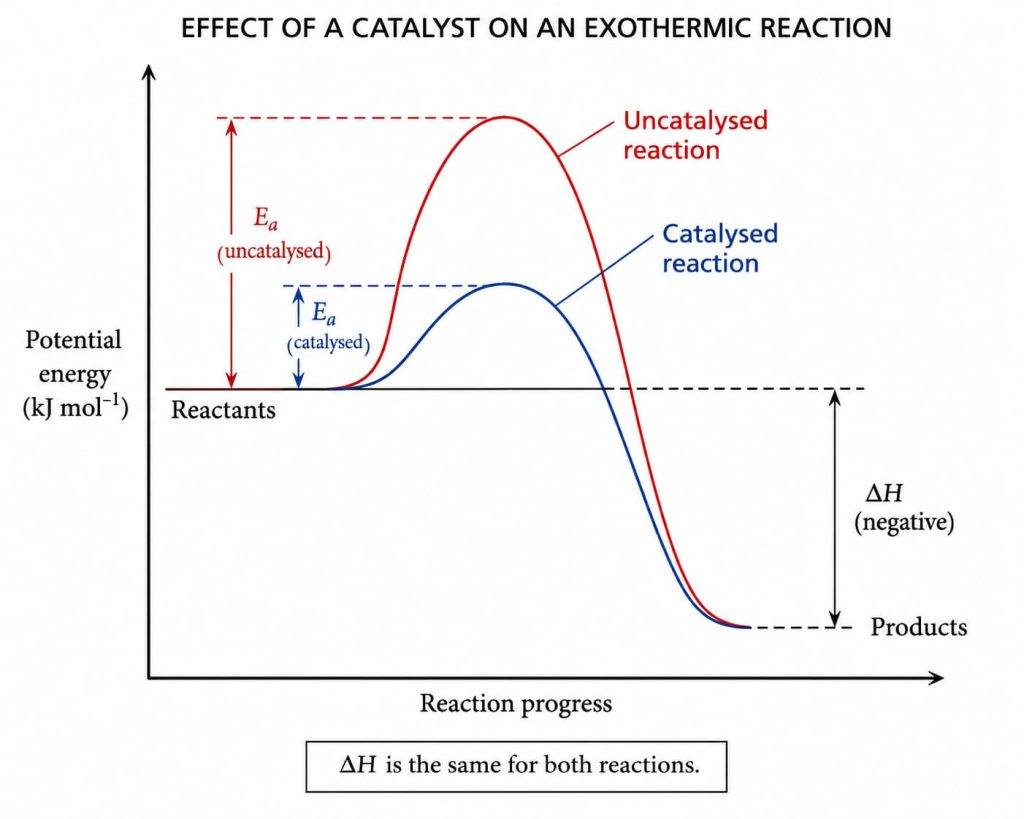
Effect of catalyst on an exothermic reaction:
(i) The catalysed reaction has lower activation energy than the uncatalysed reaction.
(ii) The catalyst provides an alternative pathway for the reaction.
(iii) The enthalpy change, ΔH, remains the same.
(iv) The products have lower energy than the reactants because the reaction is exothermic.
(3bi)
Endothermic reaction absorbs heat from the surroundings, while exothermic reaction releases heat to the surroundings.
(3bii)
Le Chatelier’s principle states that if a constraint such as change in temperature, pressure or concentration is imposed on a system in equilibrium, the equilibrium position will shift in order to oppose the change.
(3biii)
(PICK ANY THREE)
(i) Change in temperature
(ii) Change in pressure
(iii) Change in concentration
(iv) Addition of catalyst
(3ci)
I. Saturated solution: A saturated solution is a solution that contains the maximum amount of solute it can dissolve at a given temperature.
II. Molar solution: A molar solution is a solution that contains one mole of solute dissolved in one cubic decimetre of solution.
(3cii)
Sodium trioxocarbonate (IV) = Na₂CO₃
Molar mass of Na₂CO₃ = 2(23) + 12 + 3(16)
= 46 + 12 + 48
= 106 gmol⁻¹
Concentration = 0.2 moldm⁻³
Volume = 250 cm³
Volume = 250/1000 = 0.25 dm³
Number of moles = Concentration × Volume
= 0.2 × 0.25
= 0.05 mol
Mass = Number of moles × Molar mass
= 0.05 × 106
= 5.3 g
Mass of sodium trioxocarbonate (IV) needed = 5.3 g
Number 4
(4ai)
A buffer solution is a solution that resists a change in its pH when a small quantity of acid or alkali is added to it.
(4aii)
(PICK ANY TWO)
(i) It is used to maintain the pH of biological fluids such as blood.
(ii) It is used to calibrate pH meters.
(iii) It is used to maintain constant pH in chemical and industrial processes.
(iv) It is used in the manufacture of medicines.
(4bi)
The process used in the production of ammonia is the Haber process.
(4bii)
(PICK ANY TWO)
(i) Nitrogen is a colourless gas.
(ii) It is odourless.
(iii) It is tasteless.
(iv) It is only slightly soluble in water.
(v) It is less dense than air.
(4biii)
The two allotropes of carbon are:
(i) Diamond
(ii) Graphite
(4biv)
(i) Diamond: It has a giant three-dimensional tetrahedral structure in which each carbon atom is covalently bonded to four other carbon atoms.
(ii) Graphite: It has a layered hexagonal structure in which each carbon atom is covalently bonded to three other carbon atoms. The layers are held together by weak forces.
(4bv)
One use of charcoal is as an adsorbent for removing colour, odour and impurities from substances.
(4ci)
(i) Alkenes: CₙH₂ₙ
(ii) Alkynes: CₙH₂ₙ₋₂
(4cii)
The possible structural isomers of C₄H₁₀ are:
(i) CH₃—CH₂—CH₂—CH₃
(ii)
CH₃
|
CH₃—CH—CH₃
(4ciii)
(i) Butane
(ii) 2-methylpropane
(4civ)
Assume 100 g of the compound.
Carbon:
60/12 = 5
Hydrogen:
13.3/1 = 13.3
Oxygen:
26.7/16 = 1.66875
Divide by the smallest value:
C = 5/1.66875 = 3
H = 13.3/1.66875 = 8
O = 1.66875/1.66875 = 1
Empirical formula = C₃H₈O
Empirical formula mass:
= 3(12) + 8(1) + 16
= 36 + 8 + 16
= 60
n = Molar mass/Empirical formula mass
n = 60/60
n = 1
Molecular formula = C₃H₈O
Number 5
(5ai)
Octane rating is the percentage by volume of 2,2,4-trimethylpentane (iso-octane) in a mixture of iso-octane and n-heptane which has the same knocking characteristics as the fuel being tested.
(5aii)
(i) Cracking involves breaking large hydrocarbon molecules into smaller alkanes and alkenes, while reforming involves rearranging straight-chain hydrocarbons into branched-chain, cyclic or aromatic hydrocarbons.
(ii) Cracking increases the supply of smaller useful hydrocarbons, while reforming improves the octane rating and quality of petrol.
(5bi)
(DIAGRAM)
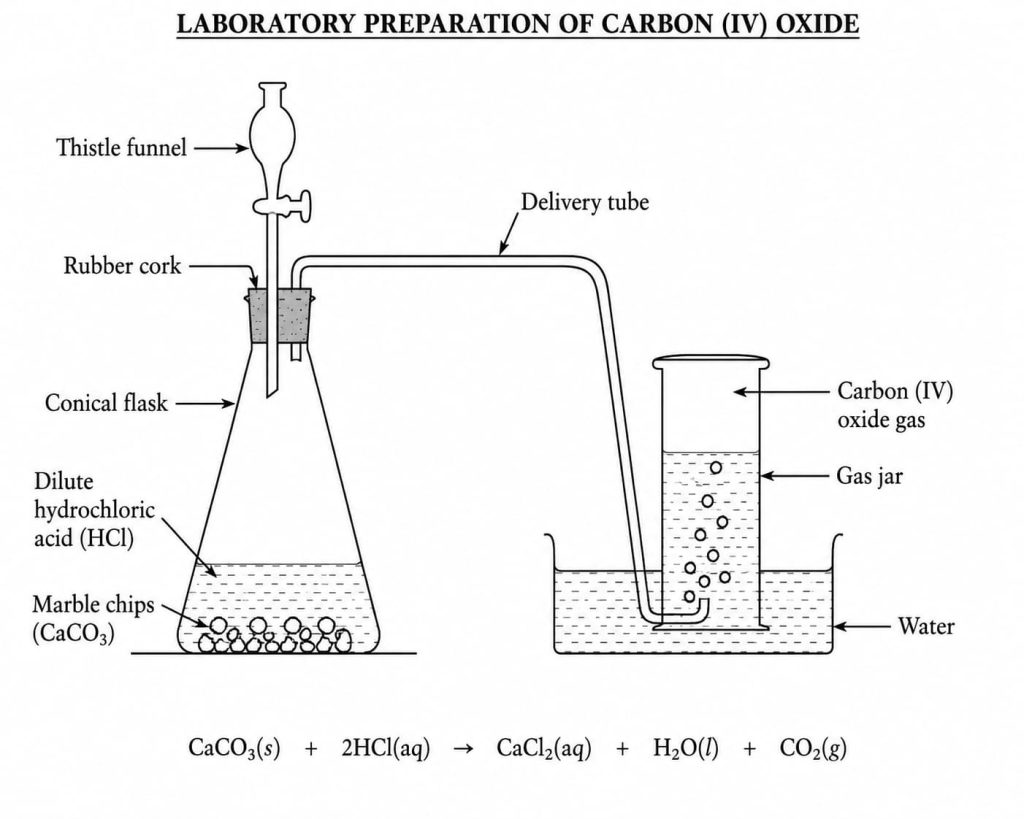
(5bii)
CaCO₃(s) + 2HCl(aq) → CaCl₂(aq) + H₂O(l) + CO₂(g)
(5biii)
(PICK ANY TWO)
(i) It is used in fire extinguishers.
(ii) It is used in the manufacture of carbonated drinks.
(iii) It is used as dry ice for refrigeration and preservation.
(iv) It is used by plants during photosynthesis.
(5ci)
Vulcanization is the process of heating natural rubber with sulphur to improve its strength, elasticity, hardness and resistance to heat and wear.
(5cii)
I. Natural rubber: Latex obtained from the rubber tree.
II. Synthetic rubber: Buna-S/Styrene-butadiene rubber.
(5ciii)
Solubility of NaCl at 100°C = 39.8 g per 100 g of water
Mass of water = 80 g
Mass of NaCl dissolved at 100°C:
= 39.8/100 × 80
= 31.84 g
Solubility of NaCl at 15°C = 35.9 g per 100 g of water
Mass remaining dissolved at 15°C:
= 35.9/100 × 80
= 28.72 g
Mass precipitated:
= 31.84 − 28.72
= 3.12 g
Mass of sodium chloride precipitated = 3.12 g
Number 6
(6ai)
A peroxide is a compound containing the peroxide ion, O₂²⁻, in which two oxygen atoms are joined by a single bond.
(6aii)
I. Example of a peroxide: Hydrogen peroxide, H₂O₂.
II. Example of a monobasic acid: Hydrochloric acid, HCl.
III. Two physical properties of acids:
(i) Acids have a sour taste.
(ii) Acids are generally soluble in water.
(iii) Their aqueous solutions conduct electricity.
(6aiii)
A strong electrolyte is a substance that ionizes completely in water or in the molten state and conducts electricity strongly.
(6aiv)
One example of a strong electrolyte is hydrochloric acid, HCl.
(6bi)
The pH of a solution is the negative logarithm to base ten of its hydrogen ion concentration.
pH = −log₁₀[H⁺]
(6bii)
I. Most acidic: Solution A, pH 2.
II. Most basic: Solution E, pH 12.
III. Neutral: Solution C, pH 7.
(6biii)
A deliquescent compound absorbs moisture from the atmosphere until it dissolves in the absorbed water, while an efflorescent compound loses some or all of its water of crystallization when exposed to air.
(6biv)
Deliquescent compound: Calcium chloride, CaCl₂.
Efflorescent compound: Washing soda, Na₂CO₃·10H₂O.
(6ci)
(PICK ANY TWO)
(i) Pure water is colourless.
(ii) Pure water is odourless.
(iii) Pure water is tasteless.
(iv) Water freezes at 0°C.
(v) Water boils at 100°C at standard atmospheric pressure.
(6cii)
Mass of vessel containing gas X = 28.92 g
Mass of empty vessel = 26.42 g
Mass of gas X = 28.92 − 26.42
= 2.50 g
Mass of equal volume of hydrogen = 0.31 g
Vapour density of gas X:
V.D. = Mass of gas X / Mass of equal volume of hydrogen
V.D. = 2.50 / 0.31
V.D. = 8.06
Relative molecular mass = 2 × Vapour density
= 2 × 8.06
= 16.12
Relative molecular mass of gas X = 16.1