
NECO Physics OBJ
01-10: BAEDEDCCEE
11-20: DEECBCCCCC
21-30: BCDDBACDEA
31-40: ACDCAECEAE
41-50: CEECDCADCD
51-60: EEBDBDAAEC
COMPLETED!!!
NECO Physics Essay
Number 1
(1a)
(PICK ANY TWO)
(i) Armature coil/insulated copper wire.
(ii) Strong magnet/field magnet.
(iii) Split-ring commutator.
(iv) Carbon brushes.
(v) Soft iron core.
(1b)
Flat plate collector: This is a solar collector that absorbs solar energy directly without concentrating the sun’s rays at a focus. It is simple in construction and is used for low temperature heating.
Focusing collector: This is a solar collector that uses a mirror or lens to concentrate the sun’s rays at a focus. It produces higher temperature than a flat plate collector.
(1c)
Magnification of objective lens, Mo = 4
Magnifying power of microscope, M = 20
M = Mo × Me
20 = 4 × Me
Me = 20 / 4
Me = 5
Magnification of the eyepiece = 5
Number 2
(2a)
The two physical quantities measured in metre per second are:
(i) Speed
(ii) Velocity
(2b)
(i) Speed is the rate of change of distance with time, while velocity is the rate of change of displacement with time.
(ii) Speed is a scalar quantity because it has magnitude only, while velocity is a vector quantity because it has both magnitude and direction.
(iii) Speed does not depend on direction, while velocity depends on direction.
(iv) Speed = Distance / Time
(v) Velocity = Displacement / Time
Number 3
(3a)
The mathematical relationship between the period T and length L of a simple pendulum is:
T = 2π√(L/g)
OR
T² = 4π²L/g
(3b)
Angular speed, ω = 0.5π rad s⁻¹
ω = 2π/T
T = 2π/ω
T = 2π / 0.5π
T = 4 s
Period = 4 s
Number 4
(4a)
Let the mass of body P = m
Velocity of P = 30 ms⁻¹
Mass of Q = 10 kg
Velocity of Q = -15 ms⁻¹
Common final velocity = 25 ms⁻¹
Using the principle of conservation of linear momentum:
m₁u₁ + m₂u₂ = (m₁ + m₂)v
m(30) + 10(-15) = (m + 10)25
30m – 150 = 25m + 250
30m – 25m = 250 + 150
5m = 400
m = 400 / 5
m = 80 kg
Mass of P = 80 kg
(4b)
The collision is an inelastic collision.
It is a perfectly inelastic collision because after collision, both bodies move together in the same direction with the same velocity.
Number 5
(5a)
(PICK ANY TWO)
(i) Pulley
(ii) Wheel and axle
(iii) Inclined plane
(iv) Screw
(v) Wedge
(5b)
Potential energy is the energy possessed by a body due to its position or state, while kinetic energy is the energy possessed by a body due to its motion.
Number 6
(6a)
(PICK ANY TWO)
(i) Ultraviolet rays
(ii) X-rays
(iii) Gamma rays
(6b)
Mechanical waves require a material medium for their propagation, while electromagnetic waves do not require a material medium for their propagation.
Number 7
Frequency, f = 50 Hz
Speed in first region, v₁ = 1.0 ms⁻¹
Speed in second region, v₂ = 0.4 ms⁻¹
Using:
v = fλ
λ = v / f
For the first region:
λ₁ = v₁ / f
λ₁ = 1.0 / 50
λ₁ = 0.02 m
For the second region:
λ₂ = v₂ / f
λ₂ = 0.4 / 50
λ₂ = 0.008 m
Difference in wavelengths = λ₁ – λ₂
= 0.02 – 0.008
= 0.012 m
Difference in wavelengths = 0.012 m
Number 8
(8a)
The statement that the escape velocity of a satellite from the earth is 11 km/s means that the satellite must be projected with a minimum velocity of 11 km/s in order to escape completely from the earth’s gravitational field without falling back to the earth.
(8b)
One advantage of a lead acid accumulator over a wet Leclanche cell is that a lead acid accumulator is rechargeable, while a wet Leclanche cell is not easily rechargeable.
OR
A lead acid accumulator can supply a large current for a longer time than a wet Leclanche cell.
Number 9
Galvanometer resistance, G = 5 Ω
Full scale deflection current, Ig = 20 mA
Ig = 20 / 1000 = 0.02 A
Current to be measured, I = 10 A
Current through shunt, Is = I – Ig
Is = 10 – 0.02
Is = 9.98 A
Using:
IgG = IsS
S = IgG / Is
S = 0.02 × 5 / 9.98
S = 0.10 / 9.98
S = 0.010 Ω
The value of the resistor = 0.01 Ω
Number 10
(10a)
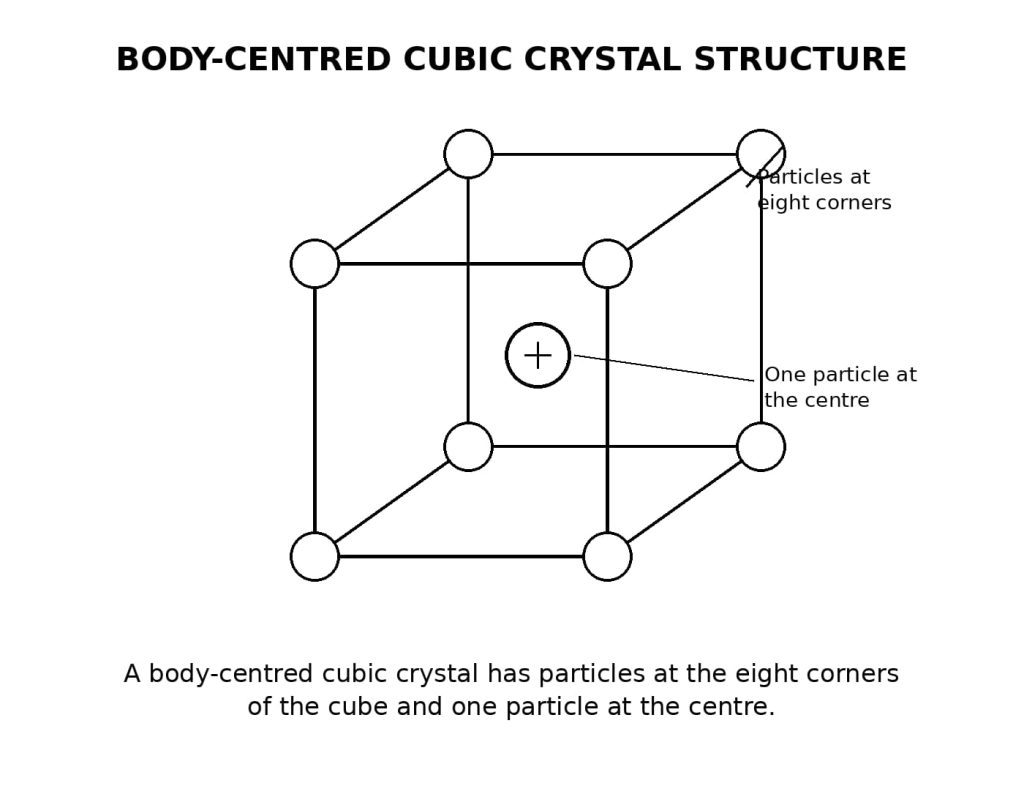
A body-centred cubic crystal has particles at the eight corners of the cube and one particle at the centre of the cube.
(10b)
Two ways of reducing the surface tension of water are:
(i) By adding soap or detergent to the water.
(ii) By increasing the temperature of the water.
Number 11
(11a)
Two components of a photocell are:
(i) Photoemissive cathode
(ii) Anode/collector plate
(11b)
Given:
vₑ = h / mₑλₑ
Kinetic energy, K.E = 1/2 mₑvₑ²
Substitute vₑ = h / mₑλₑ
K.E = 1/2 mₑ(h / mₑλₑ)²
K.E = 1/2 mₑ × h² / mₑ²λₑ²
K.E = h² / 2mₑλₑ²
Number 12
(12a)
The principle of floatation states that when a body floats in a fluid, it displaces a weight of fluid equal to its own weight.
OR
For a floating body, the upthrust acting on the body is equal to the weight of the body.
(12b)
Cone resting on its base: It is in stable equilibrium because it has a wide base and low centre of gravity. When slightly displaced, it tends to return to its original position.
Cone resting on its apex: It is in unstable equilibrium because it has a narrow base and high centre of gravity. When slightly displaced, it falls away from its original position.
(12c)
Mass of body = M
Initial velocity = u
Final velocity = v
Time taken = t
Acceleration, a = (v – u) / t
From Newton’s second law,
F = Ma
F = M(v – u) / t
Therefore,
F = M(v – u) / t
(12d)
Mass, m = 400 g = 0.4 kg
Period, T = 2.0 s
(i) Frequency, f = 1 / T
f = 1 / 2
f = 0.5 Hz
(ii) Spring constant,
T = 2π√(m/k)
T² = 4π²m / k
k = 4π²m / T²
k = 4 × (3.14)² × 0.4 / (2)²
k = 4 × 9.86 × 0.4 / 4
k = 3.94 N/m
Spring constant = 3.94 N/m
Number 13
(13a)
A claw hammer is termed a first class lever because its fulcrum is between the effort and the load when it is used to pull out a nail.
(13bi)
It is not advisable to sterilize a clinical thermometer in boiling water because the high temperature of boiling water may cause the mercury to expand beyond the limit of the capillary tube and break the thermometer.
(13bii)
(DIAGRAM)
(13c)
(i)
(DIAGRAM)
(ii)
(DIAGRAM)
(13d)
Mass of copper ball = 50 g = 0.05 kg
Temperature of copper ball = 120°C
Final temperature = 30°C
Mass of copper calorimeter = 80 g = 0.08 kg
Mass of water = 100 g = 0.10 kg
Specific heat capacity of water = 4.2 × 10³ Jkg⁻¹K⁻¹
Specific heat capacity of copper = 4.0 × 10² Jkg⁻¹K⁻¹
Let the initial temperature of water = θ
Heat lost by copper ball = Heat gained by water + Heat gained by copper calorimeter
0.05 × 400 × (120 – 30) = [0.10 × 4200 × (30 – θ)] + [0.08 × 400 × (30 – θ)]
0.05 × 400 × 90 = 420(30 – θ) + 32(30 – θ)
1800 = 452(30 – θ)
30 – θ = 1800 / 452
30 – θ = 3.98
θ = 30 – 3.98
θ = 26.02°C
Temperature of the water = 26°C
Number 14
(14a)
A wavefront is a line or surface joining all points of a wave that are in the same phase of vibration.
(14bi)
I. Searchlight: Parallel beam.
II. Bulb: Divergent beam.
(14bii)
Regular reflection occurs when parallel rays of light are reflected from a smooth surface in one direction, while diffuse reflection occurs when parallel rays of light are reflected from a rough surface in different directions.
(14ci)
Closed pipe at fundamental frequency:
Closed end: Node
Open end: Antinode
Diagram:
Closed end | N ~~~~~~~~ A | Open end
(14cii)
Length of closed pipe, L = 50 cm
L = 0.50 m
For a closed pipe at fundamental frequency:
L = λ / 4
λ = 4L
λ = 4 × 0.50
λ = 2.0 m
Wavelength = 2.0 m
Speed of sound, v = 340 ms⁻¹
Fundamental frequency, f = v / λ
f = 340 / 2.0
f = 170 Hz
For a closed pipe, first overtone = 3rd harmonic
Frequency of first overtone = 3f
= 3 × 170
= 510 Hz
Frequency of first overtone = 510 Hz
Number 15
(15ai)
Electric current is the rate of flow of electric charge through a conductor.
I = Q/t
(15aii)
(PICK ANY TWO)
(i) Length of the conductor.
(ii) Cross-sectional area of the conductor.
(iii) Nature of the material of the conductor.
(iv) Temperature of the conductor.
(15bi)
(DIAGRAM)
(15bii)
(DIAGRAM)
(15ci)
For the parallel resistors:
R₁ = 2Ω
R₂ = 5Ω
1/Rp = 1/R₁ + 1/R₂
1/Rp = 1/2 + 1/5
1/Rp = 5/10 + 2/10
1/Rp = 7/10
Rp = 10/7
Rp = 1.43Ω
Combined resistance of the parallel resistors = 1.43Ω
(15cii)
Resistance in series with the parallel combination = 4Ω
External resistance = 4Ω + 1.43Ω
External resistance = 5.43Ω
Internal resistance = 0.5Ω
Total resistance = 5.43Ω + 0.5Ω
Total resistance = 5.93Ω
E.m.f = 2V
I = E/R
I = 2/5.93
I = 0.337A
Total current = 0.34A
Number 16
(16a)
Viscosity is the internal friction between the layers of a fluid which opposes the flow of the fluid.
(16b)
(DIAGRAM)
(16c)
Half-life = 4 days
Initial mass = 15 g
| Time(days) | Mass remaining(g) |
|---|---|
| 0 | 15.000 |
| 4 | 7.500 |
| 8 | 3.750 |
| 12 | 1.875 |
| 16 | 0.938 |
(i)
(GRAPH)
(ii)
From the graph, the mass remaining after 15 days is approximately 1.1 g.
Using calculation:
Mass remaining = 15 × (1/2)^(15/4)
Mass remaining = 15 × (1/2)^3.75
Mass remaining ≈ 1.1 g
Number 17
(17a)
A continuity tester is used to check whether there is a complete path for current to flow in an electrical circuit.
OR
It is used to detect breaks or faults in a wire, fuse or electrical circuit.
(17b)
(PICK ANY TWO)
(i) Use of a pulley to draw water from a well.
(ii) Use of a wheelbarrow to carry loads.
(iii) Use of a screw jack to lift a car.
(iv) Use of a knife to cut objects.
(v) Use of an inclined plane to roll heavy loads upward.
(17c)
One advantage of using a prism over a mirror in a periscope is that a prism gives a brighter and clearer image because it reflects light by total internal reflection.
(17d)
| Cell | Positive terminal | Negative terminal | Electrolyte |
|---|---|---|---|
| Leclanche (Wet) | Carbon rod | Zinc rod | Ammonium chloride solution |
| Nickel iron | Nickel plate | Iron plate | Potassium hydroxide solution |
(17e)
Image size = 110 cm
Object size = 10 cm
Image distance, v = 100 cm
(i)
Magnification, m = Image size / Object size
m = 110 / 10
m = 11
Magnification = 11
(ii)
Magnification, m = v / u
11 = 100 / u
u = 100 / 11
u = 9.09 cm
Object distance = 9.09 cm