
WAEC Biology OBJ
Please; Use This Answers to trace on ur booklet
1. D – blood group
2. C – discontinuous
3. B – formed in anaphase II
4. C – 75%
5. C – anaphase of mitosis
6. A – 8
7. A – haemophilia
8. B – a stable environment
9. C – variation
10. B – sedimentary rocks
11. B – numbers
12. A – grasses
13. D – faeces
14. C – one partner benefits and the other neither loses nor benefits
15. D – periodic shedding of exoskeleton for growth
16. D – possesses haustoria
17. B – using old newspapers to make tissue papers
18. B – Increase in number of antelopes
19. D – petroleum, coal, tin and copper
20. D – exploiting new crude oil reserves
21. C – I and II only
22. B – fertilization
23. A – undergo mitotic division
24. B – earthworm and hydrostatic skeleton
25. C – parenchyma
26. A – erythrocyte
27. C – is excreted with minimal water loss
28. C – maintenance of a steady internal environment of the body
29. C – imbibition
30. D – medulla oblongata
31. A – oestrogen
32. A – a virus
33. B – Spirogyra → fern → cycad → Tridax
34. C – possess chlorophyll
35. B – mitochondrion
36. B – II, IV and V
37. D – photosynthesis
38. B – Contractile vacuole and kidney
39. B – movement and nutrition
40. B – chloroplast
41. A – carbon (IV) oxide
42. A – potometer
43. C – stomata
44. D – NADP
45. C – hydra
46. B – saprophytic
47. B – diabetes
48. C – increased competition and food shortage
49. A – encourage birth control measures
50. A – light, rainfall and temperature
COMPLETED!!!
WAEC Biology Essay
Number 1
(1ai)
Pollination
(1aii)
Pollination is the transfer of pollen grains from the anther of a flower to the stigma of the same flower or another flower of the same species. Bees help in this process by carrying pollen grains on their hairy bodies while moving from one flower to another to collect nectar.
(1bi)
Bees:
(i) Presence of hairy body that traps pollen grains
(ii) Presence of mouthparts adapted for sucking nectar
(1bii)
Plants:
(i) Brightly coloured petals that attract bees
(ii) Production of nectar or sweet scent that attracts bees
(1c)
Plants provide nectar as food for the bees.
(1di)
(i) Stamen
(ii) Pistil/Carpel
(1dii)
(i) Petals
(ii) Sepals
(1e)
(i) One male nucleus fuses with the egg cell to form the zygote which later develops into the embryo.
(ii) The second male nucleus fuses with the two polar nuclei to form the endosperm nucleus which later develops into the endosperm.
(1f)
(i) The fruit has a dry pod which splits open explosively when mature.
(ii) The pod twists and throws the seeds away from the parent plant.
(1g)
Complete the table;
Under; Types of placentation:
(i) Marginal placentation
(ii) Axile placentation
(iii) Parietal placentation
Under; Fruit
(i) Cowpea
(ii) Okra
(iii) Pawpaw
Number 2
(2a)
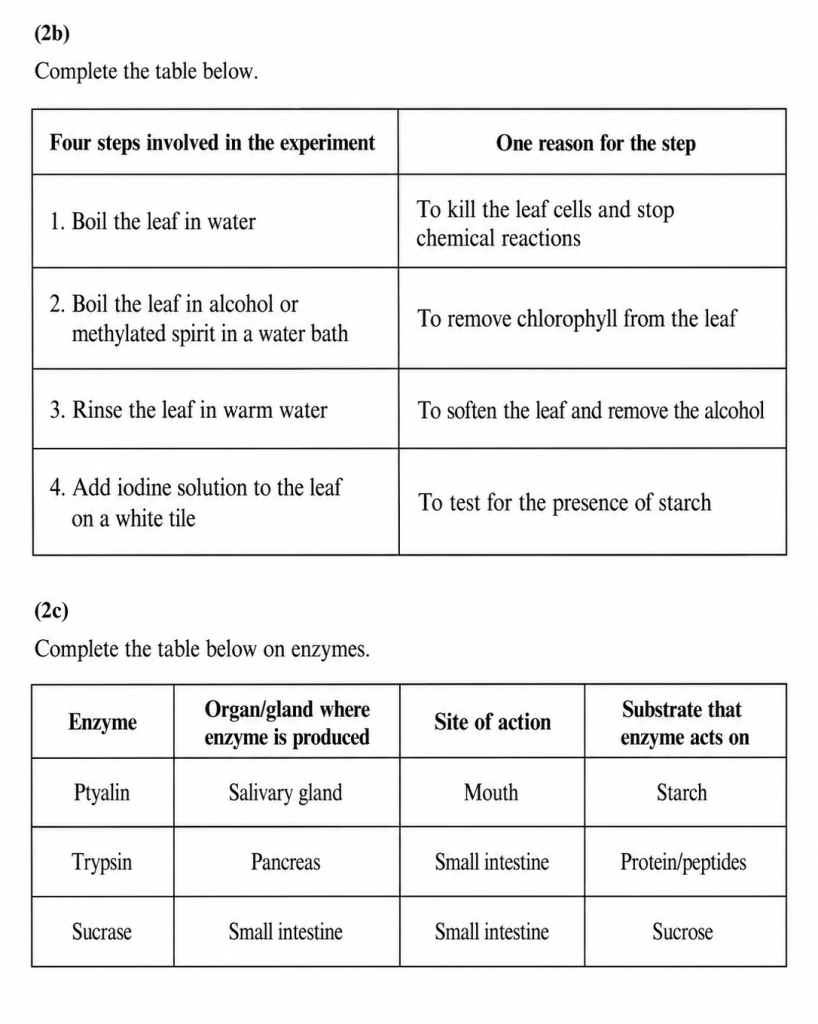
Translocation is the movement of manufactured food from the leaves to other parts of the plant through the phloem. The food is usually transported in soluble form, mainly as sucrose, to areas where it is needed or stored.
Number 3

(3bi)
Iroko
(3bii)
(PICK ANY ONE)
(i) Quadrat sampling
(ii) Transect method
(iii) Plot sampling
(3c)
Population density = Population ÷ Area
= 5 ÷ 1000
= 0.005 plants/m²
(3di)
(PICK ANY FOUR)
(i) Establishment of forest reserves.
(ii) Afforestation (planting of trees).
(iii) Reforestation of deforested areas.
(iv) Enforcement of laws against illegal logging.
(v) Establishment of national parks/game reserves.
(vi) Public education on conservation.
(vii) Controlled harvesting of forest resources.
(viii) Prevention of bush burning.
(3dii)
(PICK ANY FOUR)
(i) Source of timber for construction and furniture.
(ii) Source of medicinal plants.
(iii) Helps regulate climate and rainfall.
(iv) Prevents soil erosion.
(v) Provides employment opportunities.
(vi) Conserves biodiversity.
(vii) Serves as a source of food and raw materials.
(viii) Acts as a recreational and tourist centre.
Number 4
(4a)
Colony; the behaviour is called social behaviour/eusociality.
(4b)
Complete the table;
Under; Four likely members of the insect community:
(i) Queen
(ii) King/Drone
(iii) Worker
(iv) Soldier
Under; One role of the member:
(i) Queen: Lays eggs for reproduction
(ii) King/Drone: Fertilizes the queen
(iii) Worker: Searches for food and cares for the young ones
(iv) Soldier: Defends and protects the colony
Under; One structure for performing the role:
(i) Queen: Well-developed ovaries/large abdomen
(ii) King/Drone: Reproductive organ
(iii) Worker: Strong legs/mandibles
(iv) Soldier: Strong mandibles
(4c)
(i) Termites
(ii) Honey bees
(4di)
(i) It promotes division of labour among members of the colony.
(ii) It ensures protection and defence of the colony.
(iii) It helps in proper care of the young ones.
(4dii)
(i) Chemical signals/pheromones
(ii) Body movements/dancing
Number 5


COMPLETED!!!