
Number 1
(1a)
Fill the table;
Under; TEST
(i) Iodine test
(ii) Biuret test
(iii) Grease spot test/filter paper test
Under; OBSERVATION
(i) No blue-black colouration; iodine remains brown/yellow-brown
(ii) Purple/violet colouration appears
(iii) Translucent/greasy spot is seen on the filter paper
Under; INFERENCE
(i) Starch is absent
(ii) Protein is present
(iii) Fat/oil is present
(1b)
(PICK ANY FIVE)
(i) It is rich in protein needed for growth and repair of body tissues.
(ii) It contains fat/oil which provides energy for metabolic activities.
(iii) It contains mineral salts needed for bone and teeth development.
(iv) It contains vitamins needed for healthy growth.
(v) It provides energy needed for the child’s physical activities.
(vi) It helps in building body tissues in a growing child.
(1ci)
Legume/pod.
(1cii)
It develops from a single carpel and splits along two sides when ripe to release its seeds.
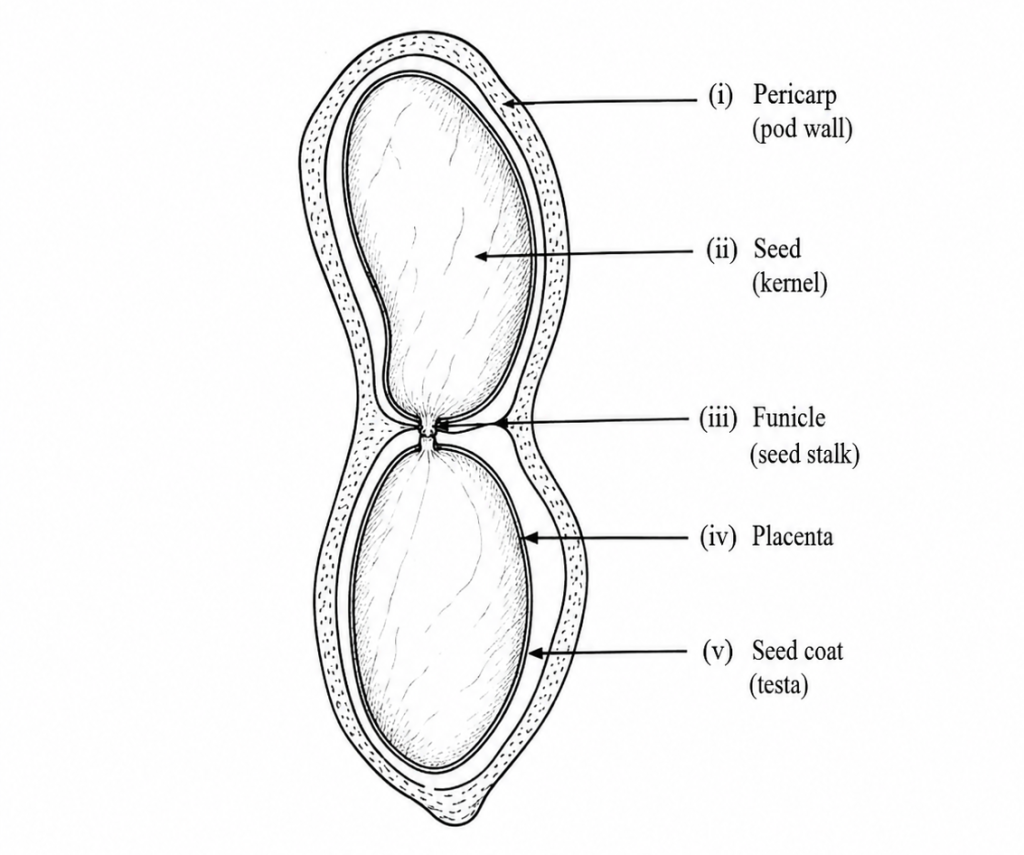
(1d)
Diagram
ANOTHER NUMBER 1
(1a)
Fill the table;
Under; TEST
(i) Iodine test
(ii) Biuret test
(iii) Grease spot test
Under; OBSERVATION
(i) Iodine remains yellow-brown/no blue-black colour is seen
(ii) Purple/violet colour is seen
(iii) A translucent oily spot is seen on the filter paper
Under; INFERENCE
(i) Starch is absent
(ii) Protein is present
(iii) Fat/oil is present
(1b)
(PICK ANY FIVE)
(i) It contains protein which helps in the growth of the child.
(ii) It contains protein which helps to repair worn-out body tissues.
(iii) It contains fat/oil which supplies energy to the body.
(iv) It contains mineral salts needed for the development of strong bones and teeth.
(v) It contains vitamins which help the child to grow healthily.
(vi) It provides nutrients needed for proper body development.
(vii) It helps to prevent poor growth in an actively growing child.
(1ci)
Legume/pod.
(1cii)
It is a dry dehiscent fruit which develops from one carpel and splits along two sides when mature to release its seeds.
(1d)
Draw the longitudinal section of specimen A and label:
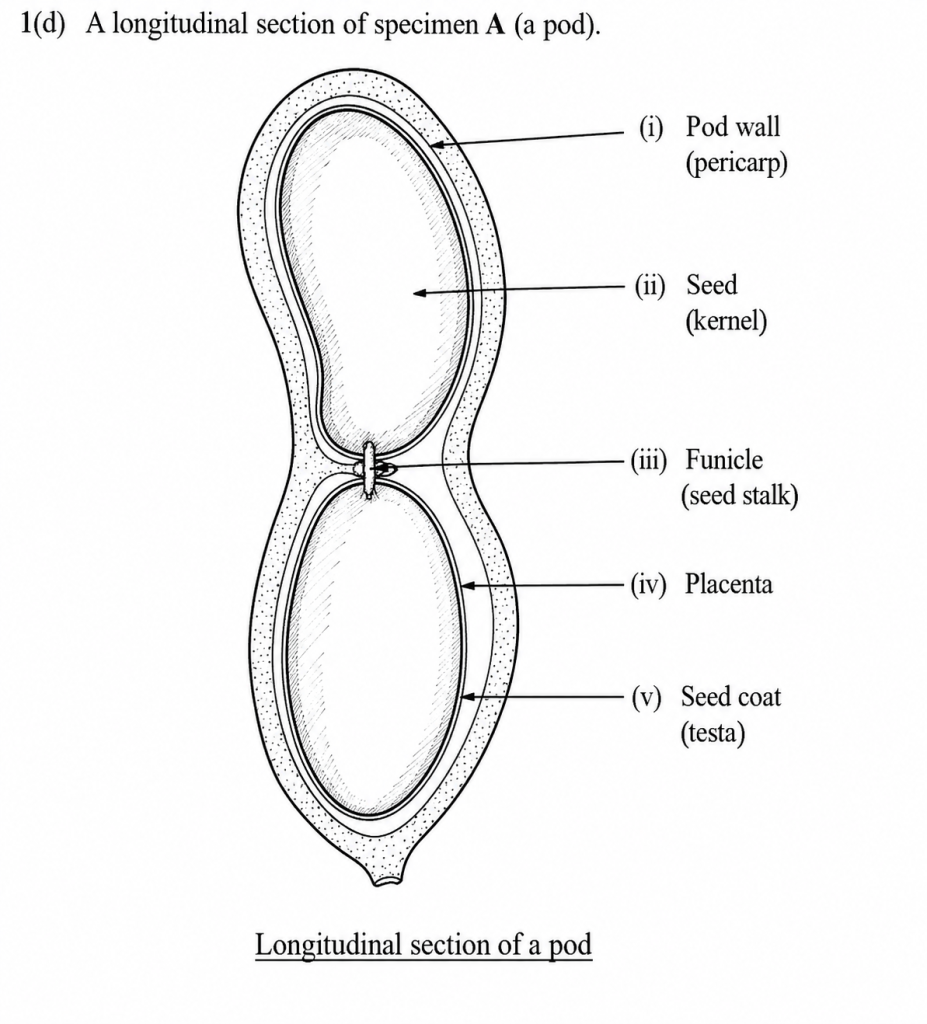
(i) Pod wall/pericarp
(ii) Seed
(iii) Seed coat/testa
(iv) Funicle
(v) Placenta
Number 2
(2ai)
(i) Peristalsis
(ii) Chemical digestion
(2aii)
(i) Peristalsis occurs in the oesophagus.
(ii) Chemical digestion occurs in the stomach.
(2b)
(i) It has muscular walls for churning/mixing food.
(ii) It has a narrow tubular oesophagus for movement of food.
(iii) It has folded inner walls/rugae for expansion.
(iv) It has a sac-like stomach for temporary storage of food.
(2c)
(i) Pepsin
(ii) Rennin/Gastric lipase
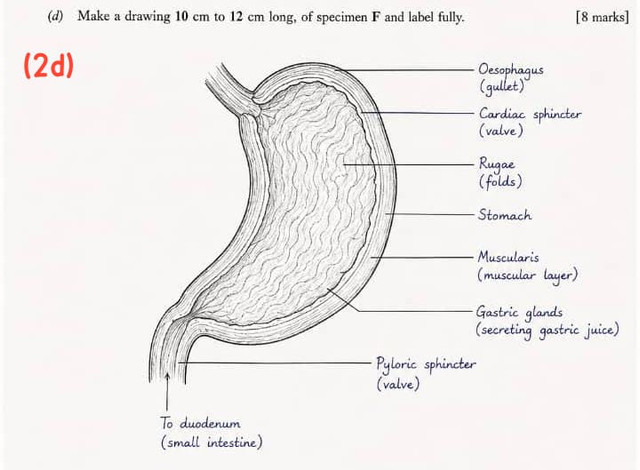
(2d)
Label for specimen f:
(i) Oesophagus/gullet
(ii) Cardiac sphincter
(iii) Rugae/folds
(iv) Stomach
(v) Muscularis/muscular layer
(vi) Gastric glands
(vii) Pyloric sphincter
(viii) To duodenum/small intestine
(2ei)
Parasitism.
(2eii)
Specimen G benefits by obtaining water and mineral salts from the host plant, while the host plant is harmed.
(2eiii)
Presence of haustoria/sucking roots which penetrate the host plant and absorb water and mineral salts.
ANOTHER NUMBER 2
(2ai)
(i) Peristalsis
(ii) Chemical digestion
(2aii)
(i) Peristalsis occurs in the oesophagus.
(ii) Chemical digestion occurs in the stomach.
(2b)
(i) Specimen F has a narrow tubular oesophagus for the passage of food to the stomach.
(ii) Specimen F has a sac-like stomach for temporary storage of food.
(iii) The stomach has thick muscular walls for churning and mixing food.
(iv) The inner wall of the stomach has folds/rugae which allow expansion when food enters.
(2c)
(i) Pepsin
(ii) Rennin/Gastric lipase
(2d)
(2ei)
Parasitism/partial parasitism.
(2eii)
Specimen G benefits by obtaining water and mineral salts from the host plant, while the host plant is harmed.
(2eiii)
Presence of haustoria/sucking roots which penetrate the host plant and absorb water and mineral salts.
(2eiv)
(i) It reduces the growth of the twig/branch.
(ii) It causes wilting or drying of the twig/branch.
(2ev)
Mistletoe growing on mango/orange/cashew tree.
Number 3
(3a)
Complete the table;
Under; Material for preservation:
(i) Refrigerator
(ii) Salt
(iii) Fire
(iv) Empty tin
(v) Sunlight
Under; One specimen that could be preserved with material:
(i) J
(ii) J
(iii) J
(iv) L
(v) K
Under; Name of method of preservation:
(i) Refrigeration/freezing
(ii) Salting
(iii) Smoking/drying
(iv) Canning
(v) Sun-drying
Under; One reason for preservation method:
(i) Low temperature slows down the activities of microorganisms.
(ii) Salt removes water from microorganisms and prevents their growth.
(iii) Heat kills microorganisms and reduces the moisture content of the food.
(iv) The tin prevents entry of air and microorganisms.
(v) Sunlight removes moisture from the food and prevents the growth of microorganisms.
(3b)
(i) Bacteria
(ii) Fungi
(3c)
(i) Weevil
(ii) Grain moth
(3d)
Fill the table;
Under; SPECIMEN
(i) P – Thermometer
(ii) Q – Metre rule
(iii) R – Quadrat
Under; ECOLOGICAL FACTOR IT IS USED FOR
(i) Temperature
(ii) Distance/length/height
(iii) Population density/frequency/distribution of organisms
Under; HABITAT WHERE SPECIMEN IS USED
(i) Aquatic or terrestrial habitat
(ii) Aquatic or terrestrial habitat
(iii) Terrestrial habitat/grassland
(3e)
A quadrat is placed or thrown randomly on the ground in the study area. All the organisms found inside the quadrat are counted and recorded. This is repeated in different parts of the habitat. The results are then used to estimate the population density, frequency and distribution of organisms in the habitat.