
WAEC Commerce OBJ
NOTE: USE THIS TO TRACE CAREFULLY IF THE OBJECTIVE QUESTION PAPER WHERE RESHUFFLED
1. B. trade and auxiliaries to trade
2. C. computers to conduct business
3. B. primary occupation
4. D. land
5. A. it faces unlimited liability
6. B. participating preference shareholders
7. D. consortium
8. B. public company
9. C. interest
10. B. Distribution of goods to customers
11. A. trade association
12. A. sex
13. A. insufficient capital
14. A. D 3,000
15. D. D 6,000
16. D. 3,000
17. D. terms of trade
18. D. customs duties
19. A. Central Bank
20. D. bonus issue
21. B. assured value
22. D. shares
23. A. bulk purchase
24. C. commission
25. B. Retail
26. B. dock warrant
27. D. bonded warehouse
28. C. motherboard
29. A. store of value
30. B. finance the purchase of equipment
31. B. contribution
32. B. informative advertising
33. B. television
34. C. sales promotion
35. A. written communication
36. B. lapse of time
37. C. regulates businesses
38. B. increase investment
39. D. demographic
40. B. provision of pipe borne water
41. D. Penetration
42. C. copyright
43. C. Standard Organization Act
44. C. span of control
45. C. futures price
46. D. setting company goals
47. A. privatization
48. A. improvement of revenue base
49. A. 1964
50. D. Togo
COMPLETED!!!
WAEC Commerce Essay
Number 1
(1a)
Commerce is the buying, selling and distribution of goods and services through physical or traditional means, while e-commerce is the buying and selling of goods and services through the internet or other electronic means.
Commerce usually involves face-to-face contact between buyers and sellers, while e-commerce allows buyers and sellers to transact online without physical contact.
Commerce may require a physical shop or marketplace, while e-commerce can be carried out through websites, mobile apps and online platforms.
(1b)
(i) Business to customer: This is a type of e-commerce where a business sells goods or services directly to final consumers through the internet. For example, a customer buying clothes, phones or food from an online store.
(ii) Government to business: This is a type of e-commerce where government agencies provide services or information to business organizations through electronic means. For example, online tax payment, business registration, licence renewal and submission of company documents to government agencies.
(1c)
Advantages of e-commerce:
(PICK ANY TWO)
(i) It saves time because customers can buy goods and services online without going to a physical shop.
(ii) It reduces the cost of running a business because the seller may not need many physical shops.
(iii) It allows buying and selling to take place at any time of the day.
(iv) It helps businesses to reach customers in different locations.
Disadvantages of e-commerce:
(PICK ANY THREE)
(i) There may be internet fraud or online scam.
(ii) Customers may not be able to inspect goods physically before buying.
(iii) Poor internet connection can affect online transactions.
(iv) It may lead to delay in delivery of goods.
(v) Some customers may not know how to use online platforms properly.
Number 2
(2a)
Division of labour is the system of production in which a work or production process is divided into different stages, and each stage is assigned to a particular worker or group of workers. Under division of labour, each worker specializes in one part of the production process instead of doing the whole work alone. This helps to increase speed, skill and efficiency in production.
(2b)
(PICK ANY THREE)
(i) Capital is man-made: Capital refers to wealth or assets produced by man and used for further production, such as machines, tools and buildings.
(ii) Capital is used for further production: Capital is not mainly used for direct satisfaction of wants but for producing more goods and services.
(iii) Capital is durable: Most forms of capital, such as machines, buildings and vehicles, can be used for a long period of time.
(iv) Capital depreciates: Capital goods may lose value over time as a result of wear and tear, usage or passage of time.
(v) Capital increases productivity: The use of capital helps labour to produce more goods within a shorter period.
(vi) Capital is mobile: Some forms of capital, such as vehicles, tools and machines, can be moved from one place to another.
(2c)
(i) Extraction: Extraction is an occupation that involves obtaining raw materials and natural resources directly from nature. It includes activities that take resources from the land, sea, rivers, forests or underground. These raw materials may later be used by manufacturing industries to produce finished goods.
Examples:
(i) Farming
(ii) Fishing
(iii) Mining
(iv) Lumbering/forestry
(ii) Manufacturing: Manufacturing is an occupation that involves changing raw materials into finished or semi-finished goods through the use of labour, machines, tools and capital. It adds value to raw materials by processing them into goods that can satisfy human wants or be used for further production.
Examples:
(i) Textile production
(ii) Bread baking
(iii) Furniture making
(iv) Cement production
(v) Soap making
Number 3
(3ai)
Producer cooperative society.
(3aii)
(PICK ANY FOUR)
(i) It is formed by producers who come together to promote their common economic interest.
(ii) Members are usually involved in the same or similar occupation, such as farming, fishing or manufacturing.
(iii) It helps members to buy tools, equipment, raw materials and other inputs at cheaper prices.
(iv) It helps members to market or sell their products collectively.
(v) It is owned and controlled by the members.
(vi) Each member has one vote, regardless of the amount of capital contributed.
(vii) Profit or surplus is shared among members based on their level of participation or patronage.
(viii) It is formed mainly to support members rather than to make excessive profit.
(3b)
(PICK ANY FIVE)
(i) It has limited liability, meaning shareholders cannot lose more than the amount they invested in the company.
(ii) It has a separate legal existence from its owners, so it can sue and be sued in its own name.
(iii) It has continuity because the death or withdrawal of a shareholder does not end the business.
(iv) It can raise more capital than a sole proprietorship or ordinary partnership.
(v) It enjoys better management because directors may be appointed to manage the business.
(vi) It is easier to expand because it can attract investors and obtain loans from financial institutions.
(vii) Shares can be transferred privately, subject to the company’s rules.
(viii) The accounts and affairs of the company are more private than those of a public company.
Number 4
(4a)
(PICK ANY FIVE)
(i) Hawkers sell goods at cheaper prices than supermarkets.
(ii) Hawkers move from place to place, making goods easily available to customers.
(iii) Hawkers sell in small quantities which poor customers can afford.
(iv) Hawkers are found in streets, markets, schools, bus stops and residential areas.
(v) Hawkers offer personal attention to customers.
(vi) Customers can bargain prices easily with hawkers.
(vii) Hawkers operate with little capital and do not need expensive buildings.
(viii) Hawkers save customers the stress of going to supermarkets.
(ix) Some hawkers sell goods on credit to familiar customers.
(x) Hawkers can operate at convenient times and places.
(4b)
(PICK ANY FIVE)
(i) A hypermarket is a very large retail store that sells many varieties of goods.
(ii) It combines the features of a supermarket and a departmental store.
(iii) It usually operates on a self-service basis.
(iv) It sells both food and non-food items.
(v) It usually has large parking space for customers.
(vi) It sells goods at relatively low prices because it buys in large quantities.
(vii) It is usually located in large buildings or shopping complexes.
(viii) It uses modern equipment such as trolleys, shelves, scanners and electronic payment systems.
(ix) It offers customers a wide range of products under one roof.
(x) It is usually owned and operated by large business organizations.
Number 5
(5a)
(PICK ANY FIVE)
(i) Performance of the contract by both parties.
(ii) Agreement between the parties to end the contract.
(iii) Breach of contract by one of the parties.
(iv) Frustration of contract due to an unforeseen event.
(v) Impossibility of performance.
(vi) Lapse of time fixed for the contract.
(vii) Death or insanity of one of the parties, especially in personal contracts.
(viii) Bankruptcy of one of the parties.
(ix) Operation of law.
(x) Destruction of the subject matter of the contract.
(5b)
(i) Sale of Goods Act: This is an Act that regulates the buying and selling of goods. It protects both buyers and sellers by stating their rights and duties in a contract of sale. It ensures that goods sold must correspond with description, be of good quality and be fit for the purpose for which they are bought.
(ii) Foods and Drugs Act: This is an Act that controls the production, sale and distribution of food and drugs. It protects consumers from harmful, fake, adulterated or expired food and drugs. It also ensures that food and drugs sold to the public are safe for consumption and properly labelled.
(iii) Standard Organization Act: This is an Act that establishes a body responsible for setting and maintaining standards for goods and services. It ensures that products meet the required quality and safety standards before they are sold to consumers. It also helps to prevent the sale of substandard goods.
(iv) Factory, Shops and Offices Act: This is an Act that protects workers in factories, shops and offices. It provides rules on safety, health, working conditions, ventilation, cleanliness, working hours and welfare of workers. It helps to prevent accidents and poor working conditions in business premises.
(v) Hire Purchase Act: This is an Act that regulates hire purchase transactions. It protects the buyer and seller in an agreement where goods are taken and paid for by instalments. The buyer can use the goods while paying gradually, but ownership fully passes to the buyer only after the final payment is made.
Number 6
(6a)
Business management is the process of planning, organizing, directing, coordinating and controlling the activities and resources of a business in order to achieve its goals. It involves using human, financial, material and other resources effectively to produce goods or services and make profit.
(6b)
(i) Economic environment: Economic environment refers to the economic conditions and factors that affect the activities and performance of a business. These factors include inflation, interest rate, exchange rate, taxation, income level of consumers, unemployment, availability of credit and general economic growth. A favourable economic environment helps business to grow, while an unfavourable one can reduce sales and profit.
(ii) Social environment: Social environment refers to the customs, beliefs, values, lifestyle, education, religion and attitudes of people in the society where a business operates. It affects the type of goods and services people demand. For example, changes in fashion, taste, family size, culture and standard of living can influence business decisions.
(6c)
(PICK ANY FOUR)
(i) Human resources: These are the people who work in the business, such as managers, supervisors, clerks, machine operators and sales workers. They provide the skills, knowledge and labour needed for the operation of the business.
(ii) Financial resources: These are the funds or money available to a business for carrying out its activities. They are used to buy goods, pay workers, acquire machines, expand the business and meet daily expenses.
(iii) Material resources: These are the raw materials, goods, tools, machines, equipment and other physical items used in production or business operation. They help the business to produce goods and services.
(iv) Time resources: Time is an important business resource because every business activity must be done within a given period. Proper use of time helps to increase efficiency and reduce delay or waste.
(v) Information resources: These are facts, records and data used by a business to make decisions. Information about customers, prices, competitors, market demand and government policies helps the business to plan properly.
(vi) Technological resources: These include machines, computers, internet facilities, software and modern methods used to improve business operations. Technology helps a business to produce faster, reduce cost and serve customers better.
Number 7
(7a)
Deregulation.
(7b)
(PICK ANY FOUR)
(i) Poor management: The company may have been managed by people who lacked the required skills and experience, leading to poor decisions and wastage of resources.
(ii) Government interference: Too much interference by government officials may have affected the smooth running of the company and prevented quick business decisions.
(iii) Overstaffing: The company may have employed more workers than necessary, thereby increasing the cost of operation.
(iv) Corruption and mismanagement of funds: Money meant for the running and maintenance of the company may have been diverted or misused.
(v) Poor maintenance of vehicles: Failure to maintain buses, cars or other vehicles properly could lead to frequent breakdown and poor service.
(vi) Low fares: The company may have charged fares that were too low to cover the cost of operation.
(vii) Lack of competition: Since the company was government-owned, it may not have faced serious competition and this could make workers careless and inefficient.
(viii) Poor attitude of workers: Workers may have been lazy, rude to customers or careless because they felt the business belonged to the government.
(7c)
Advantages of deregulation:
(PICK ANY TWO)
(i) It encourages competition among firms, which can lead to better services.
(ii) It reduces government spending on inefficient businesses.
(iii) It allows private investors to participate in the industry.
(iv) It can lead to improved efficiency and better management.
Disadvantages of deregulation:
(PICK ANY THREE)
(i) It may lead to increase in prices or transport fares.
(ii) Private operators may exploit consumers in order to make more profit.
(iii) Some workers may lose their jobs after deregulation.
(iv) Essential services may become difficult for poor people to afford.
(v) Private firms may concentrate only on profitable routes and neglect rural areas.
(vi) It may lead to unhealthy competition among firms.
Number 8
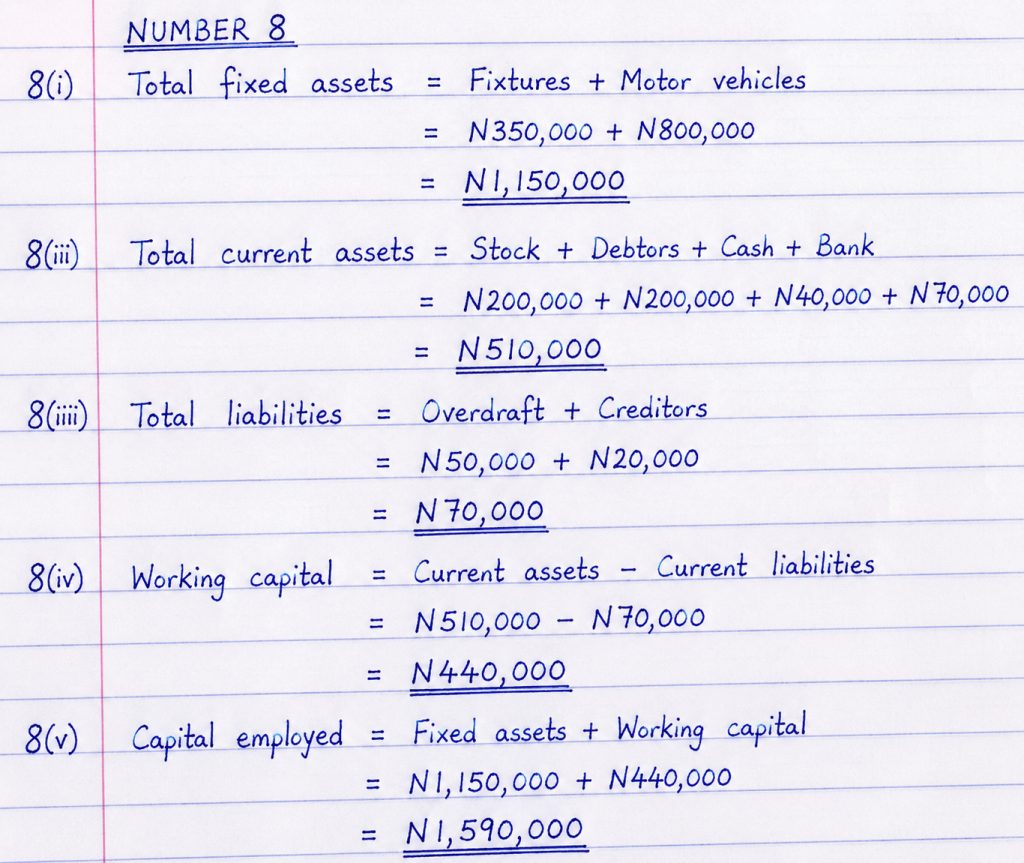
COMPLETED!!!