WAEC Literature OBJ
01-10: DCDCADBBDB
11-20: BBDBDDBBDD
21-30: DACCACCACC
31-40: BBADCBDBAD
41-50: CBCAAABADD
COMPLETED!!!
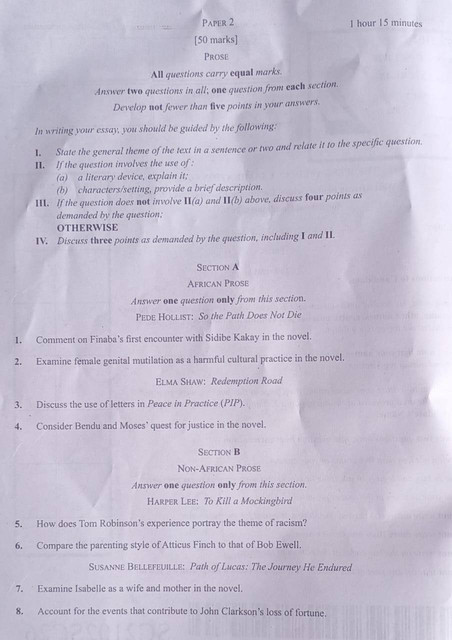
WAEC Literature Prose
African Prose
Answer one question only from this section.
Number 1
(1)
In Pede Hollist’s So the Path Does Not Die, Finaba’s first encounter with Sidibe Kakay is important because it shows her strength, honesty and self-respect. It also introduces Sidibe as a rich and powerful man who believes that his money can make people obey him.
Finaba Marah is the main character in the novel. She is a determined young woman who has suffered a lot but still tries to live a good life. Sidibe Kakay, on the other hand, is a wealthy diamond trader. He is influential and used to getting what he wants because of his money and position.
Their first encounter takes place when Finaba is working at the clinic. Sidibe comes there and tries to use his influence to get more drugs than he is supposed to receive. He expects Finaba to obey him because he is rich and powerful. However, Finaba refuses to do what is wrong. She does not allow his money or status to influence her decision.
This encounter shows that Finaba is honest and disciplined. Even though she is not a rich person, she does not allow poverty or pressure to make her behave wrongly. Her refusal proves that she has strong moral values and respect for her work.
Sidibe is surprised by Finaba’s behaviour. Instead of leaving her alone, he becomes more interested in her. He sees her as a woman who is different from others and begins to admire her. This also shows his belief that a woman can be won over through wealth and persistence.
The encounter also reveals the problem of male power in the society. Sidibe believes that because he is wealthy, he can influence people, especially women. Finaba’s refusal challenges this belief. She shows that a woman can stand firm and make her own decision.
In conclusion, Finaba’s first encounter with Sidibe Kakay is important because it reveals the difference between the two characters. Sidibe represents wealth, influence and moral weakness, while Finaba represents honesty, courage and self-respect.
ANOTHER VERSION
(1)
In Pede Hollist’s So the Path Does Not Die, Finaba’s first encounter with Sidibe Kakay is an important incident in the novel. Through this meeting, the writer shows the kind of person Finaba is and also reveals the character of Sidibe Kakay.
Finaba Marah is presented as a young woman with self-respect and discipline. She is not easily moved by money or the influence of rich people. Sidibe Kakay, on the other hand, is a wealthy and powerful man. He is used to getting what he wants because of his position in society.
Their first meeting takes place at the clinic where Finaba works. Sidibe comes to the clinic and tries to get more drugs than he is supposed to receive. He believes that because he is rich and important, Finaba will obey him without question. However, Finaba refuses to do what is wrong.
This refusal shows Finaba’s honesty. She does not allow Sidibe’s wealth or influence to make her break the rules of her work. Even though she knows that Sidibe is a powerful man, she stands by what is right. This makes her different from people who can be easily bought with money.
The encounter also shows Sidibe’s pride. He expects people to fear him or respect him because of his wealth. He does not expect a woman like Finaba to reject his request. When she refuses him, he becomes surprised and interested in her. To him, Finaba is not like other women he can easily control.
Also, the meeting brings out the issue of male dominance in the society. Sidibe believes that as a rich man, he can influence a woman and make her do what he wants. But Finaba’s action proves that a woman can be bold and firm. She does not behave like someone who is helpless before a man.
The encounter also prepares the reader for the later relationship between Finaba and Sidibe. Sidibe’s interest in her begins from this first meeting. He sees her as a strong woman, but he also wants to win her over. This shows that the first encounter is not just an ordinary meeting; it is important to the development of the story.
In conclusion, Finaba’s first encounter with Sidibe Kakay reveals the difference between the two characters. Finaba represents honesty, courage and self-respect, while Sidibe represents wealth, pride and male power. Through this meeting, the writer shows that Finaba is a woman who can stand firm even when she is faced with pressure from a powerful man.
Number 2
(2)
In Pede Hollist’s So the Path Does Not Die, female genital mutilation is presented as a harmful cultural practice. The practice is seen by some people in the society as a tradition that must be followed, but the novel shows that it brings pain, fear and suffering to girls and women.
Female genital mutilation is the cutting of the female private part for cultural reasons. In the novel, Finaba is almost forced to go through this practice when she is still young. Her grandmother, Baramusu, believes strongly in the tradition and wants the path of the ancestors to continue. However, the experience shows that not all traditions are good.
Firstly, the practice is harmful because it causes serious physical pain. A young girl who is forced to pass through it suffers greatly. The cutting is done on a sensitive part of the body, and this can lead to bleeding and other health problems. The novel shows that the practice is not a harmless ceremony but a dangerous act.
Secondly, it can lead to death. The death of Dimusu after the initiation shows how dangerous the practice is. This makes it clear that female genital mutilation can destroy lives. A tradition that can kill a young girl should not be encouraged.
Thirdly, the practice causes fear and emotional pain. Finaba is frightened by what happens during the initiation. Even though the process is stopped, the memory remains with her. This shows that the practice does not only hurt the body; it also affects the mind of the victim.
Also, female genital mutilation denies girls the right to decide what happens to their own bodies. Finaba is not allowed to make her own choice. Older people try to force the practice on her because they believe it is part of their culture. This shows how girls are sometimes treated as if they have no voice.
Another harmful effect is that it causes conflict in the family. Baramusu supports the practice, while Finaba’s parents do not want her to suffer it. This creates disagreement in the family. Through this, the writer shows that harmful traditions can bring division among family members.
The practice also affects Finaba’s identity. Because her initiation is not completed, she feels different and unsettled. She struggles with the feeling that something is missing in her life. This shows how a harmful culture can continue to affect a person even after many years.
In conclusion, female genital mutilation is shown in the novel as a harmful cultural practice because it causes pain, fear, death, family conflict and loss of freedom. Through Finaba’s experience, the writer teaches that culture is important, but any culture that destroys the life and happiness of girls should be stopped.
ANOTHER VERSION
(2)
In Pede Hollist’s So the Path Does Not Die, female genital mutilation is shown as a dangerous and painful cultural practice. The people who support it see it as part of their tradition, but the novel shows that it brings suffering to young girls and women.
Female genital mutilation is the cutting of a girl’s private part for traditional reasons. In the novel, Finaba is almost made to pass through this practice when she is young. Her grandmother, Baramusu, believes that the practice must continue because it is part of their culture. She feels that a girl is not complete without it. However, the experience of Finaba shows that the practice is harmful.
One reason why the practice is harmful is that it causes serious pain. A young girl who is forced into it suffers greatly. The cutting is done without proper medical care, and this can lead to bleeding and infection. This shows that the practice puts the life of the girl in danger.
Another reason is that it can lead to death. In the novel, Dimusu dies after the initiation. Her death shows clearly that the practice is not safe. A custom that can kill a young girl should not be defended in the name of tradition.
Also, female genital mutilation brings fear to girls. Finaba is afraid during the initiation. She does not fully understand what is happening, but she knows that she is in danger. Even when the process is stopped, the fear and memory remain with her. This shows that the practice can affect a person’s mind for a long time.
The practice also takes away the freedom of girls. Finaba is not allowed to decide for herself. Older people make the decision for her because they believe that tradition must be obeyed. This shows how girls are sometimes forced to accept painful customs without their consent.
Furthermore, the practice causes disagreement in the family. Baramusu wants Finaba to be initiated, but Finaba’s parents are against it. This brings conflict between the old generation and the younger generation. Through this, the writer shows that not all old customs should be followed blindly.
The practice also affects Finaba’s life as she grows older. Because her initiation is not completed, she feels different from others. This makes her search for herself and her identity. The incident follows her even when she leaves her home and goes to another country.
In conclusion, female genital mutilation is presented as a harmful cultural practice in the novel. It causes pain, fear, death, family conflict and emotional suffering. Through Finaba’s experience, the writer teaches that culture is important, but any culture that destroys the life and happiness of girls should be rejected.
Number 3
(3)
In Elma Shaw’s Redemption Road, letters are used in Peace in Practice as a means of healing and self-expression. Peace in Practice, also called PIP, is the organization where Bendu and Agnes help victims of war to recover from their painful experiences. Through the use of letters, the writer shows that speaking about pain is not always easy, but writing can help victims to release what is hidden in their hearts.
One important use of letters in PIP is that they help victims to express their pains. Many of the people who come to PIP have suffered during the war. Some of them have been raped, beaten, separated from their families or forced to witness terrible things. Such people may not find it easy to talk openly about their experiences. Writing letters gives them another way to pour out their feelings.
The letters also serve as a form of counselling. At PIP, victims are encouraged to write, not necessarily because the letters will be sent to anybody, but because the act of writing can help them face their past. This shows that healing is not only about forgetting the past. Sometimes, a person has to remember the past, speak about it and gradually overcome it.
Another use of letters is that they reveal hidden stories. Through the letters, the reader gets to know things that some characters may not have said openly. For example, Tenneh’s letter reveals more about her painful experience and how she was handed over to the people who later hurt her. This helps the reader to understand the depth of her suffering.
The letters also help in character development. Through what the characters write, we understand their fears, regrets and hopes. A character who appears quiet may have many painful memories inside. Through the letters, such memories are brought out. This makes the characters look more real and human.
In addition, the letters help to develop the theme of trauma. The novel is about people who are trying to recover from the damage caused by war. The letters show that war does not only destroy buildings and properties; it also destroys the minds of people. Many survivors continue to suffer even after the fighting has ended.
The letters also support the theme of healing and forgiveness. By writing, the victims begin to confront the people and events that hurt them. This does not mean that their pain disappears immediately, but it is a step towards recovery. It shows that peace must begin from the heart before it can spread to the society.
Furthermore, the letters make the story more interesting. Instead of allowing the narrator to explain everything, the writer allows some characters to speak for themselves through letters. This gives the reader a closer understanding of their personal experiences.
In conclusion, the use of letters in Peace in Practice is very important in Redemption Road. The letters help the victims to express their pain, reveal hidden stories, develop characters and support the themes of trauma, healing and forgiveness. Through them, Elma Shaw shows that writing can help wounded people begin their journey towards peace.
ANOTHER VERSION
(3)
In Elma Shaw’s Redemption Road, the use of letters in Peace in Practice is very important. Peace in Practice, also known as PIP, is an organization that helps people who have suffered during the war. The letters written by the victims help them to express their pain and begin the process of healing.
Many of the victims in the novel have gone through terrible experiences. Some lost their loved ones, while others were abused, tortured or separated from their families. Because of these painful experiences, they find it difficult to talk openly about what happened to them. Through letter writing, they are able to say what they cannot easily say with their mouths.
The letters also help the victims to release their hidden feelings. A person who keeps pain inside may continue to suffer in silence. At PIP, the victims are encouraged to write about their experiences. This helps them to face their past and reduce the burden in their hearts.
Another importance of the letters is that they reveal the suffering caused by the war. Through the letters, the reader understands that war does not only destroy houses and towns. It also destroys people’s peace of mind. Many people continue to suffer even after the war has ended because of the bad memories they carry.
The letters also help to tell the stories of characters who may not be able to speak freely. Some characters are ashamed or afraid to talk about their past. But when they write, their true feelings are revealed. This makes the reader understand them better.
In addition, the letters help in the development of the theme of healing. PIP is interested in helping people recover from their painful past. The letters become one of the ways through which the victims start their journey towards peace. Writing does not remove their suffering immediately, but it helps them to take the first step.
The use of letters also makes the novel more interesting. Instead of allowing the narrator to explain everything, the writer allows some characters to speak for themselves. This makes their experiences more personal and touching.
Furthermore, the letters show the need for truth. Before people can truly heal, they must face the truth about what happened to them. The letters help the victims to remember, confess and confront their painful memories.
In conclusion, the use of letters in Peace in Practice is important because it helps victims to express their pain, reveal their experiences, face the truth and begin to heal. Through the letters, Elma Shaw shows that writing can help people who have been wounded by war to find peace again.
Number 4
(4)
In Elma Shaw’s Redemption Road, Bendu and Moses are important characters in the presentation of the quest for justice. Bendu Lewis is a victim of the Liberian civil war, while Moses Varney, also known as Commander Cobra, is one of the people who caused pain and suffering during the war. Their relationship in the novel shows that justice is not easy to get in a society damaged by war and corruption.
Bendu’s quest for justice begins from her painful past. During the war, she suffers greatly in Duluma Camp under Commander Cobra. She witnesses terrible things and is forced into experiences that leave deep wounds in her mind. Although she tries to forget these memories for many years, she cannot completely escape from them.
When Bendu later meets Moses Varney again, her buried pains return. She discovers that the man who once terrorised people during the war is still alive and free. This makes her feel that the victims of the war have not received justice. Bendu does not want him to continue living as if nothing happened.
Bendu’s decision to press charges against Moses shows her courage. She knows that Moses is dangerous, but she still decides to seek justice through the law. This shows that she is not only fighting for herself. She is also fighting for other victims who suffered during the war but cannot speak for themselves.
Moses, on the other hand, also talks about justice, but his own idea of justice is not pure. He has changed his name from Commander Cobra to Moses Varney, but he has not truly changed his ways. He is involved in illegal activities and tries to protect himself through powerful people. This shows that some former war criminals try to hide under new names and positions after the war.
Moses also tries to stop Bendu from exposing him. He threatens her and reminds her of her own painful past. He wants to silence her so that he will not face punishment for his crimes. This shows that his main concern is not true justice but his own safety.
The novel also shows that the search for justice is difficult in a corrupt society. People like Moses can bribe officials and use their connections to escape punishment. This makes it hard for victims like Bendu to get justice. However, Bendu’s determination shows that victims should not remain silent forever.
Bendu’s quest for justice also helps her to begin her healing. By facing Moses and speaking about her past, she begins to free herself from fear and shame. She learns that healing cannot come when painful memories are hidden forever.
In conclusion, Bendu and Moses’ quest for justice reveals two different sides of justice in the novel. Bendu seeks justice because she wants truth, healing and peace for victims of war. Moses, however, tries to avoid justice because he is guilty of many crimes. Through them, Elma Shaw shows that a country cannot truly heal after war unless truth and justice are allowed to take place.
ANOTHER VERSION
(4)
In Elma Shaw’s Redemption Road, Bendu and Moses are used to show the difficulty of seeking justice after war. The novel presents a society where many people have suffered because of the civil war, but those who caused the suffering are still moving about freely. Through Bendu and Moses, the writer shows that justice is necessary for healing to take place.
Bendu is one of the victims of the war. She suffers greatly in the hands of Commander Cobra and other fighters. The experiences she passes through leave deep pain in her mind. Although she later tries to rebuild her life, the memories of the war still trouble her.
Moses Varney is later revealed to be Commander Cobra. During the war, he was involved in wicked acts against innocent people. He represents those who committed crimes during the war but later tried to hide their past and live normal lives. His new name does not remove the evil things he did in the past.
Bendu’s quest for justice begins when she meets Moses again. Seeing him brings back the painful memories of what she suffered. She becomes disturbed because a man who caused pain to many people is still free. This makes her feel that the victims of war have been forgotten.
Bendu decides to seek justice by exposing Moses and making him face the law. This shows her courage. It is not easy for her to face a man who once had power over her, but she does it because she wants the truth to come out. Her action also speaks for other victims who are too weak or afraid to speak.
Moses, on the other hand, does not want justice. He wants to protect himself and escape punishment. He uses threats and intimidation to frighten Bendu. This shows that he is not truly sorry for what he did. He is only interested in saving himself.
The quest for justice is also difficult because the society is corrupt. People like Moses can use money and connections to escape punishment. This makes it hard for victims to get justice. The novel shows that after war, it is not enough to say that peace has returned. Those who committed crimes must also be made to answer for their actions.
Bendu’s struggle for justice also helps her healing. By speaking out, she begins to free herself from fear and shame. She understands that silence will only allow people like Moses to continue hiding.
In conclusion, Bendu and Moses show two different sides of justice in Redemption Road. Bendu wants justice because she is a victim who wants truth and healing. Moses runs away from justice because he is guilty. Through their story, Elma Shaw shows that a society cannot fully recover from war without truth, courage and justice.
Non-African Prose
Answer one question only from this section.
Number 5
(5)
In Harper Lee’s To Kill a Mockingbird, Tom Robinson’s experience shows the problem of racism in Maycomb. Tom is a black man who is accused of raping Mayella Ewell, a white girl. Although there is clear evidence that he is innocent, he is still treated unfairly because of the colour of his skin.
Tom Robinson is presented as a kind and hardworking man. He has a wife and children, and he tries to live peacefully. He only helps Mayella Ewell because he feels sorry for her. Whenever he passes by the Ewell house, Mayella sometimes asks him to help her with small jobs. Tom helps her without asking for payment because he is kind-hearted.
However, Tom’s kindness later puts him in trouble. Mayella invites him into the house and tries to get close to him. When her father, Bob Ewell, sees what happens, he becomes angry. Instead of telling the truth, Mayella accuses Tom of raping her. This false accusation becomes dangerous because Tom is a black man and Mayella is a white woman.
During the trial, Atticus Finch defends Tom Robinson. Atticus shows that Tom could not have committed the crime. Tom’s left hand is useless because it was injured when he was young. Also, Mayella’s injuries suggest that she was beaten by someone who used the left hand. This points more to Bob Ewell than to Tom Robinson.
Even with all these facts, the jury still finds Tom guilty. This shows the deep racism in Maycomb. The white men on the jury cannot accept the word of a black man against the word of a white woman. They prefer to punish an innocent black man rather than admit that a white family is lying.
Tom’s experience also shows that black people have little protection under the law. The court is supposed to be a place of justice, but in Tom’s case, justice is denied. He is judged not by the truth but by his race. This makes his case very painful and unfair.
After the trial, Tom loses hope. He knows that many people will not believe him because he is black. He tries to escape from prison and is shot dead. His death shows how cruel racism can be. An innocent man loses his life because society refuses to treat him fairly.
Tom Robinson’s experience also exposes the hypocrisy of the white community. Some people in Maycomb claim to be good and religious, but they still support injustice against black people. They do not care about Tom’s innocence because they see him as inferior.
In conclusion, Tom Robinson’s experience in To Kill a Mockingbird clearly shows racism in Maycomb. He is falsely accused, unfairly judged and finally killed because he is black. Through his story, Harper Lee shows that racism destroys justice and causes innocent people to suffer.
ANOTHER VERSION
(5)
In Harper Lee’s To Kill a Mockingbird, Tom Robinson’s experience shows the evil of racism in Maycomb. Tom is a black man who is accused of raping Mayella Ewell, a white girl. Although the facts in the case show that he is innocent, he is still found guilty because he is black.
Tom Robinson is a poor but kind man. He works hard and tries to take care of his family. He does not look for trouble. His problem starts because he helps Mayella Ewell whenever she asks him to do small jobs for her. He helps her out of pity, not because he wants anything bad from her.
One day, Mayella invites Tom into the house and tries to tempt him. When her father, Bob Ewell, sees them, he becomes angry. Mayella then accuses Tom of raping her. This accusation is false, but because Mayella is white and Tom is black, many people in Maycomb quickly believe her.
During the trial, Atticus Finch defends Tom Robinson. He shows clearly that Tom could not have committed the crime. Tom’s left hand is useless, so it would be difficult for him to beat Mayella in the way she was beaten. The evidence suggests that Bob Ewell is the person who beat Mayella, but the people of Maycomb refuse to accept the truth.
The jury still declares Tom guilty. This shows that racism is stronger than justice in Maycomb. The white people in the court are not ready to believe the word of a black man against the word of a white woman. Tom is condemned not because he is guilty, but because of his colour.
Tom’s experience also shows that black people are not treated equally under the law. The court is supposed to protect everybody, but Tom does not get fair treatment. Even when the truth is clear, the jury allows racial hatred to control their judgement.
After the trial, Tom loses hope. He knows that it will be difficult for a black man to get justice in such a society. He tries to escape from prison and is shot dead. His death is very painful because he dies for a crime he did not commit.
In conclusion, Tom Robinson’s experience in the novel shows the cruelty of racism. He is falsely accused, unfairly judged and finally killed because he is black. Through Tom’s story, Harper Lee shows that racism can destroy truth, justice and innocent lives.
Number 6
(6)
In Harper Lee’s To Kill a Mockingbird, Atticus Finch and Bob Ewell are two fathers who are very different in the way they bring up their children. Through these two men, the writer shows the difference between good parenting and bad parenting.
Atticus Finch is the father of Jem and Scout. He is a lawyer and a respected man in Maycomb. He brings up his children with love, patience and discipline. He does not rule them with fear. Instead, he teaches them by advice, example and honest discussion. He allows Jem and Scout to ask questions, and he explains things to them in a calm way.
One important thing about Atticus as a parent is that he teaches his children to respect other people. He tells Scout that she should learn to understand people by putting herself in their position. This lesson helps Scout to become more thoughtful. Atticus wants his children to know that people should not be judged quickly.
Atticus also teaches his children courage. When he agrees to defend Tom Robinson, he knows that many people in Maycomb will insult him and his family. Yet, he still does what is right. Through this, he teaches Jem and Scout that courage is not only fighting with weapons, but standing for the truth even when it is difficult.
Another good quality of Atticus is that he is honest with his children. He does not hide the truth from them unnecessarily. He explains serious matters to them in a way they can understand. He also corrects them when they are wrong. For example, when Scout gets into trouble, Atticus advises her instead of beating her harshly.
Bob Ewell, on the other hand, is a careless and irresponsible father. He is the father of Mayella and her younger brothers and sisters. He does not take good care of his children. The Ewells live in poverty and dirt near the town dump. Bob wastes his money on drinking instead of providing well for his family.
Unlike Atticus, Bob Ewell does not teach his children good morals. He is violent, lazy and dishonest. His children suffer because of his bad behaviour. Mayella, for example, lives a lonely and miserable life. She has no real care or protection from her father. Instead, Bob treats her badly and makes her life difficult.
Bob Ewell also gives his children a bad example. He lies against Tom Robinson and allows an innocent man to suffer. He is also full of hatred and revenge. After the trial, he still tries to harm Atticus’s children. This shows that he is not only a bad father but also a dangerous man.
The main similarity between Atticus and Bob Ewell is that both of them are fathers living in the same town. They both have children who are affected by their behaviour. However, the difference between them is very clear. Atticus raises his children with love, truth and discipline, while Bob Ewell raises his children in fear, neglect and bad example.
In conclusion, Atticus Finch represents good parenting, while Bob Ewell represents bad parenting. Atticus helps Jem and Scout to become responsible and fair-minded children. Bob Ewell, however, destroys his family through laziness, lies and cruelty. Through these two fathers, Harper Lee shows that children are greatly influenced by the kind of parents they have.
ANOTHER VERSION
(6)
In Harper Lee’s To Kill a Mockingbird, Atticus Finch and Bob Ewell are shown as two different fathers. Atticus is a good and responsible father, while Bob Ewell is a bad and careless father. Through them, the writer shows that the way parents train their children affects the children’s lives.
Atticus Finch is the father of Jem and Scout. He is a lawyer and a respected man in Maycomb. He loves his children and teaches them good behaviour. He does not treat them harshly, but he corrects them when they are wrong. He wants them to grow up as honest and fair people.
One good thing about Atticus is that he teaches his children to respect others. He tells Scout that she should try to understand people before judging them. This lesson helps Scout to see life from other people’s point of view. Atticus does not want his children to look down on anybody.
Atticus also teaches Jem and Scout courage. When he defends Tom Robinson, many people insult him and call him bad names. Even his children are mocked because of the case. Still, Atticus does not stop doing what is right. Through this, he teaches his children that a person must stand for the truth even when people are against him.
Another important quality of Atticus is that he is honest with his children. He explains things to them in a simple way and allows them to ask questions. He does not deceive them. This makes Jem and Scout trust him and learn from him.
Bob Ewell is different from Atticus. He is the father of Mayella Ewell and the other Ewell children. He is poor, lazy and irresponsible. He does not take proper care of his children. They live in a dirty place near the town dump, and the children suffer because of his bad way of life.
Bob Ewell is also a bad example to his children. He drinks, lies and behaves violently. He accuses Tom Robinson falsely and allows an innocent man to suffer. This shows that he does not teach his children truth or kindness.
Mayella’s life shows the effect of Bob Ewell’s bad parenting. She is lonely, unhappy and afraid. She has no proper love or guidance from her father. Instead of protecting her, Bob makes her life more miserable.
The difference between Atticus and Bob Ewell is very clear. Atticus trains his children with love, wisdom and discipline. Bob Ewell neglects his children and teaches them bad behaviour through his own actions.
In conclusion, Atticus Finch represents good parenting, while Bob Ewell represents bad parenting. Atticus helps Jem and Scout to become better children, but Bob Ewell destroys his family through laziness, lies and cruelty.
Number 7
(7)
In Susanne Bellefeuille’s Path of Lucas, Isabelle is presented as a loving wife and a caring mother. She is one of the important characters in the novel because her life is closely connected with Lucas Clarkson’s journey. Through her, the writer shows love, hardship, family life and sacrifice.
As a wife, Isabelle loves Lucas sincerely. Their love begins when they are young and it later leads to marriage. Although they do not come from the same family background, Isabelle still gives her heart to Lucas. Her love for him is not based on money or comfort alone. She sees him as someone she can trust and build a home with.
Isabelle is also a supportive wife. She stands by Lucas as they face the challenges of life. Marriage is not always easy for them, but she remains part of Lucas’s life and journey. Her presence gives Lucas happiness and a reason to continue working hard. She is not only his wife but also his companion.
Another thing about Isabelle as a wife is that she comes from a difficult background. Her family is poor, and she suffers pain and maltreatment, especially from her father. In spite of this, she does not allow her suffering to stop her from loving Lucas. Her marriage to Lucas gives her a chance to have a better family life.
As a mother, Isabelle is caring and devoted to her children. She becomes the mother of five children, and this shows her important role in the Clarkson family. She takes care of her children and gives them motherly love. Her children are part of the happiness she shares with Lucas.
Isabelle also represents the sacrifices many mothers make for their families. A good mother does not only give birth to children; she also cares for them and helps to keep the home together. Isabelle plays this role in the novel. She helps to make the family complete and meaningful.
Her death later in the novel brings sadness to Lucas and the children. This shows how important she is to the family. When a loving wife and mother dies, the home can no longer remain the same. Lucas feels the pain of losing her because she has been a major part of his life.
In conclusion, Isabelle is presented as a loving wife and a caring mother in Path of Lucas. She loves Lucas, supports him, cares for her children and helps to build the family. Through her character, the writer shows that a good wife and mother is very important in the life of a family.
ANOTHER VERSION
(7)
In Susanne Bellefeuille’s Path of Lucas, Isabelle is presented as a good wife and a caring mother. She is an important character because her life affects Lucas deeply. Through her character, the writer shows love, suffering, motherhood and the importance of family support.
Isabelle comes from a poor background. Her family life is not easy, and she suffers hardship while growing up. Her father does not treat her with enough love and care. This makes her childhood painful. In spite of this, Isabelle still grows up to become a woman who loves her family.
As a wife, Isabelle loves Lucas sincerely. Her love for him starts when they are young. Later, their relationship leads to marriage. She does not marry Lucas because of riches, but because she loves him and wants to build a life with him. This shows that she is faithful and loving.
Isabelle is also a supportive wife. She stays with Lucas as they face the problems of life together. Lucas passes through many difficulties, but Isabelle remains part of his journey. Her presence gives him joy and comfort. She helps to make his home meaningful.
As a mother, Isabelle is caring. She gives birth to children and takes care of them as a mother should. She shows motherly love to her children and plays an important role in the family. Her children are part of the happiness she shares with Lucas.
Isabelle also shows the suffering that many women face in marriage and family life. She does not live a completely easy life. She faces emotional pain and health challenges. Yet, she remains important to Lucas and the children. Her struggles make the reader feel pity for her.
Another important thing about Isabelle is that her death brings sorrow to the family. Lucas feels the pain of losing his wife because she has been very close to him. Her death shows that she is not an ordinary woman in his life. She is someone he loves deeply.
In conclusion, Isabelle is presented as a loving wife and a caring mother in the novel. She loves Lucas, supports him, cares for her children and suffers many challenges. Through her character, the writer shows that a good wife and mother is very important in the life of a family.
Number 8
(8)
In Susanne Bellefeuille’s Path of Lucas, John Clarkson’s loss of fortune is connected with old age, weakness and the difficulty of keeping the family farm. John Clarkson is Lucas’s father. At the beginning, he is presented as a hardworking and successful farmer who is able to take care of his family. However, as time goes on, his situation changes.
One event that leads to John Clarkson’s loss of fortune is his old age. Farming requires strength and constant attention. A farmer must clear the land, look after animals, plant crops and manage workers. As John grows older, he no longer has the same strength he had before. This makes it difficult for him to continue running the farm successfully.
Another event is Lucas’s movement to Uxbridge. Lucas gets an opportunity to work as a mechanic and also improve his future. This is a good opportunity for Lucas because he loves mechanic work. However, his absence affects his father. John depends on Lucas because Lucas is hardworking and useful on the farm. When Lucas leaves, the burden of the farm becomes heavier for John.
Also, John becomes worried that the farm may be lost. The farm is not just a place of work; it is the family’s source of wealth and pride. John has worked for many years to build it. When he sees that he is becoming weak and cannot manage it alone, he fears that everything he has laboured for may disappear.
Because of this, John goes to Lucas and begs him to return home. This shows how serious his condition has become. A man who was once strong and independent now needs the help of his son to protect what remains of his fortune. His plea also shows the emotional pain of a father who does not want to lose the work of many years.
Lucas later agrees to return home because of his love for his father and family. This decision shows Lucas’s sacrifice, but it also proves that John’s fortune is already in danger. If the farm were still strong and easy to manage, John would not have begged Lucas to leave his job and come back.
John Clarkson’s loss of fortune also teaches that wealth can be affected by age and family problems. A person may work hard and become successful, but sickness, old age and lack of support can change everything. John’s case shows that fortune is not always permanent.
In conclusion, the events that lead to John Clarkson’s loss of fortune include his old age, his weakness, Lucas’s absence from the farm, and the danger of losing the family farm. Through John’s experience, the writer shows that family support is very important in times of difficulty.
ANOTHER VERSION
(8)
In Susanne Bellefeuille’s Path of Lucas, John Clarkson’s loss of fortune is one of the sad events in the novel. John Clarkson is the father of Lucas. He is first presented as a hardworking man who owns a farm and depends on it for his family’s comfort. However, as time goes on, his fortune begins to reduce.
One event that leads to his loss of fortune is his old age. John Clarkson is no longer as strong as he used to be. Farming needs strength, attention and constant hard work. As he grows old, he finds it difficult to manage the farm properly. This weakness affects the progress of the farm.
Another event is the absence of Lucas from the farm. Lucas is a hardworking young man who is useful to his father. When he leaves home to work as a mechanic in Uxbridge, the farm loses an important helper. John Clarkson finds it difficult to continue the work alone. This makes the condition of the farm worse.
Also, the farm begins to suffer because there is no proper management. A farm cannot continue to produce well if it is not properly cared for. Crops must be planted, animals must be looked after, and workers must be supervised. Since John is old and weak, he cannot do all these things effectively.
John Clarkson also becomes afraid of losing the farm completely. The farm is very important to him because it is the result of many years of labour. It is also the main source of his family’s fortune. When he sees that the farm is going down, he becomes worried and helpless.
Because of this, he begs Lucas to return home. This shows that John has reached a difficult stage in his life. A man who once stood strong as the head of the family now needs the help of his son. His request shows that his fortune is already in danger.
Lucas later decides to return because he loves his father and does not want the family farm to be lost. This decision shows the importance of family support. Without Lucas, John Clarkson may not be able to save what is left of his property.
In conclusion, John Clarkson’s loss of fortune is caused by old age, weakness, Lucas’s absence, poor management of the farm and the danger of losing the family property. Through this event, the writer shows that wealth can disappear when there is no strength and support to maintain it.
COMPLETED!!!