WAEC History OBJ
01-10: DBCADCCADD
11-20: ABBCCADCDC
21-30: CCBDDCBDAA
31-40: BBDCDDCAAA
41-50: AABBBCCAAC
COMPLETED!!!
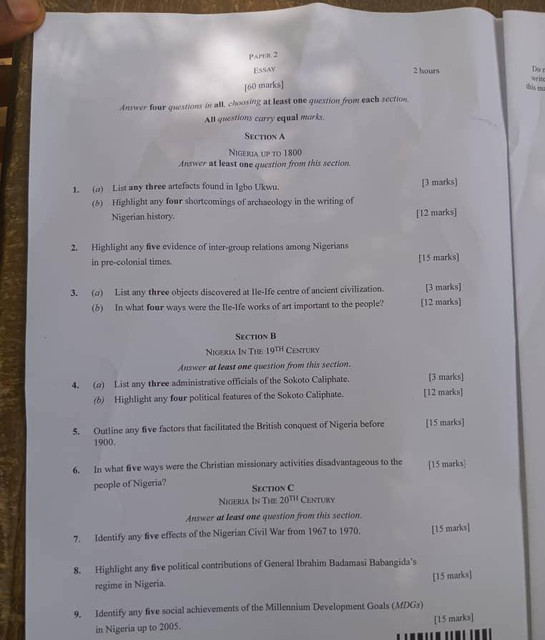
WAEC History Essay
Number 1
(1a)
(i)Leaded bronze vessels (such as the famous bronze ceremonial pot wrapped in a stylized rope mesh).
(ii)The Crescentic bronze bowl.
(iii)A bronze ceremonial vessel shaped like a snail shell topped with a leopard figurine.
(1b)
(i)Extreme vulnerability to environmental degradation: Nigeria’s highly acidic soils and harsh, humid tropical climate rapidly decompose organic materials like wood, textiles, and skeletons, leaving severe gaps in the historical record.
(ii)Severe financial and institutional underfunding: Archaeological excavations are extremely expensive, and Nigerian research institutions suffer from a lack of government funding, proper excavation laboratories, and specialized modern dating equipment.
(iii)Destruction of historical sites by human and natural activity: Rapid urbanization, modern construction, agricultural farming, deep soil erosion, and unchecked illegal looting continuously destroy or scramble crucial sites before they can be scientifically examined.
(iv)Inability to reveal non-material aspects of culture: Material artifacts alone cannot directly explain or translate abstract historical realities, such as ancient political structures, complex religious philosophies, oral literature, and the actual spoken languages of early societies.
Number 2
(2)
(i)Extensive long-distance trade networks: Regional specialization created massive mutual dependencies across geographic zones. For instance, the trade of salt from the Lake Chad basin, horses and leather from the Hausa city-states, and kola nuts, palm oil, and beads from southern forest kingdoms like Oyo and Benin.
(ii)Widespread inter-ethnic marriages: Royal lineages and common families regularly intermarried across different ethnic boundaries to secure trade alliances, cement strategic peace pacts, and establish long-term diplomatic friendships between neighbors.
(iii)Common traditions of origin and migrations: Many groups shared overlapping mythologies that tracked back to similar historical cultural centers. For example, several ruling lineages across southern Nigeria and parts of the Middle Belt trace their source authority or political descent back to the sacred center of Ile-Ife or Benin.
(iv)Shared technological and artistic traditions: Marked similarities in specialized crafts indicate a deep exchange of ideas and craftsmen. The advanced iron smelting, casting methods, and naturalistic styles found in Nok, Ife, Benin, and Igbo-Ukwu art demonstrate continuous regional interaction over centuries.
(v)Diplomatic and military alliances: Pre-colonial states frequently interacted politically. They sent emissaries, exchanged symbolic gifts, adjusted mutual borders, and formed strategic military pacts or joint coalitions to manage regional security and control trade routes.
Number 3
(3a)
(i)Naturalistic copper-alloy (bronze) royal heads.
(ii)Terracotta human sculptures and faces.
(iii)Intricate glass beads and crucibles used for glassmaking.
(3b)
(i)Facilitation of religious worship and ancestral veneration: The naturalistic sculptures served as sacred vessels or focal pieces in shrines, bridging the spiritual gap between the living community, their ancestral spirits, and deities like Oduduwa and Obatala.
(ii)Legitimization of divine royal authority: Masterfully crafted portrait heads represented real kings (Oonis) and royals, visually reinforcing their sacred, divine right to rule and preserving a physical manifestation of state hierarchy.
(iii)Use in funerary rites and succession ceremonies: The lifelike terracotta and metal figures were utilized in secondary burial ceremonies or royal funerals to represent the deceased ruler, symbolizing the continuity of the royal office despite physical death.
(iv)Documentation and preservation of historical memory: The highly specific visual details on the art pieces such as distinct facial striations, royal crowns, necklaces, and jewelry patterns effectively preserved the history, dress codes, and technological achievements of various reigns in a chronological sequence.
Number 4
(4a)
(i)Waziri (The Grand Vizier / Prime Minister)
(ii)Amir al-jaish (The Commander of the Army)
(iii)Qadi (The Chief Judge).
(4b)
(i)Theocratic Governance: The Sultan ruled as both the spiritual and political leader based strictly on Islamic law (Sharia).
(ii)Emirate System: The empire was divided into semi-autonomous emirates, each led by an Emir who pledged loyalty to the Sultan.
(iii)Dual Capital Administration: The caliphate operated two administrative headquarters, with Sokoto managing the western sector and Gwandu managing the eastern sector.
(iv)Centralized Appointment System: The Sultan retained ultimate authority to appoint, approve, or depose regional Emirs to maintain centralized control
Number 5
(5)
(i)Superior Military Weaponry: The British deployed advanced firearms, such as Maxim machine guns, against local armies carrying outdated weapons.
(ii)Internal Local Divisions: Intense rivalries and civil conflicts between indigenous kingdoms prevented a united front against British advancement.
(iii)Strategic Gunboat Diplomacy: Royal Navy ships bombarded coastal cities like Lagos to force local rulers into submission.
(iv)Deceptive Protection Treaties: British agents used ambiguous peace treaties to strip local chiefs of their sovereignty legally.
(v)Chartered Company Enforcement: The Royal Niger Company built fortified trading posts and raised private armies to crush local resistance.
Number 6
(6)
(i)Erosion of Traditional Culture: Missionaries labeled local customs, music, and clothing as pagan, leading to widespread cultural alienation.
(ii)Destruction of Indigenous Religion: Sacred shrines, artifacts, and traditional spiritual practices were systematically dismantled or demonized.
(iii)Creation of Social Division: The introduction of Christianity created deep rifts within families and communities between converts and traditionalists.
(iv)Facilitation of British Colonialism: Missionary networks softened local resistance, making it much easier for the British government to establish political control.
(v)Psychological Subjugation: Mission education often taught Eurocentric values that portrayed African heritage as inferior to Western civilization.
Number 7
(7)
(i)Massive Loss of Human Lives: Over one to three million people died from combat, disease, and starvation.Severe Economic and Infrastructure Destruction: Roads, bridges, schools, and hospitals in eastern Nigeria were completely ruined.
(ii)Extreme Malnutrition and Health Crises: Blockades led to widespread famine, resulting in severe kwashiorkor among children.
(iii)Implementation of the 3Rs Program: The federal government launched Rehabilitation, Reconstruction, and Reconciliation to rebuild the nation.
(iv)Displacement and Refugee Crisis: Millions of civilians lost their homes and became internally displaced or fled abroad.
(v)Deepened Ethnic and Political Distrust: The war created long-lasting mutual suspicion between different ethnic groups in Nigeria.
Number 8
(8)
(i)Creation of New States: He created 11 new states to promote geopolitical balance. In 1987, Akwa Ibom and Katsina were created. In 1991, nine more states followed: Abia, Anambra, Delta, Edo, Enugu, Jigawa, Kebbi, Osun, and Taraba.
(ii)Creation of More Local Governments: He created hundreds of new Local Government Areas (LGAs) across Nigeria to bring government administration closer to the grassroots level.
(iii)Establishment of a Two-Party System: He decreed a strict two-party system to eliminate ethnic voting blocks. These were the Social Democratic Party (SDP) and the National Republican Convention (NRC).
(iv)Establishment of the National Electoral Commission (NEC): He formed NEC (led by Professor Humphrey Nwosu) to build modern electoral machinery. They introduced the successful “Option A4” open-ballot voting system.
(v)Relocation of the Federal Capital to Abuja: His regime officially moved the seat of the federal government from Lagos to Abuja on December 12, 1991.
Number 9
(9)
(i)Improved Primary School Enrolment: The MDGs helped to increase the number of children attending primary school through programmes like Universal Basic Education.
(ii)Reduction in Child Mortality: More children survived because of improved immunization, better health centres, and stronger awareness on child healthcare.
(iii)Improved Maternal Healthcare: More pregnant women began to receive antenatal care, skilled birth attendance, and health education to reduce maternal deaths.
(iv)Better Access to Clean Water: Some communities gained access to boreholes, wells, and safer drinking water through government and donor-supported projects.
(v)Promotion of Gender Equality: The MDGs encouraged girl-child education and women empowerment, helping more girls to attend school and more women to participate in society.
COMPLETED!!!