
The National Examinations Council (NECO) has outlined the requirements for the 2025 Biology Practical examination. This information is highly confidential, and schools must take strict measures to ensure candidates do not access it directly or indirectly before the exam. The Biology Practical is a critical component of the NECO examination, designed to test students’ hands-on skills in observing, identifying, and analyzing biological specimens. Below is a detailed guide to the requirements, specimens, and procedures for the exam, written in simple language for easy understanding.
Candidate Requirements
Every student participating in the Biology Practical exam must come prepared with the following items:
- Sharpened HB drawing pencil: Used for making clear and accurate diagrams of specimens.
- Eraser: To correct mistakes in drawings or notes without leaving smudges.
- Ruler: For measuring specimens or drawing straight lines in diagrams.
These items are essential for completing tasks like sketching, labeling, and measuring specimens accurately. Students should ensure their pencils are sharp and ready for use to avoid disruptions during the exam.
School Responsibilities
The school is responsible for providing the following equipment for the candidates:
- Sharp razor blade or scalpel: Needed for dissecting or cutting specimens carefully.
- Petri dish: Used to hold small specimens or parts of specimens during observation.
- Hand lens: A magnifying tool to help candidates examine fine details of specimens, such as the texture of a leaf or the structure of an insect.
Schools must ensure these items are in good condition and available in sufficient quantities. If providing individual sets for each candidate is not feasible, schools can arrange for groups of up to 10 students to share a set of specimens and equipment. This ensures all candidates have access to the necessary tools without delays.
Specimens for the Examination
The Biology Practical exam will involve a variety of specimens to test candidates’ ability to observe, identify, and analyze biological structures. The following specimens will be provided during the exam:
- A: Housefly – A common insect for studying external features like wings and compound eyes.
- B: Spider – Used to examine arachnid characteristics, such as legs and body segments.
- C: Pride of Barbados Flower – A vibrant flower for studying floral parts like petals and stamens.
- D: Bean seed – For observing seed structure and germination features.
- E: Butterfly – To study insect wings, coloration, and body parts.
- F: Crayfish – A crustacean for examining aquatic adaptations and body segments.
- G: Grasshopper – For studying insect anatomy, including jumping legs and antennae.
- H: Humerus of a Rabbit – A bone to study skeletal structure and function.
- I: Femur of a Rabbit – Another bone for comparing skeletal features.
- J: Orange Fruit – For examining fruit structure and seed arrangement.
- K: Honey Bee – To study social insect features and pollination adaptations.
- L: Land Snail – For observing mollusk characteristics, like the shell and soft body.
- M: Guava Fruit – To study fruit anatomy and seed distribution.
- N: Irish Potato tuber – For examining storage organs and vegetative reproduction.
- O: Sweet Potato tuber – Another tuber for comparing underground storage structures.
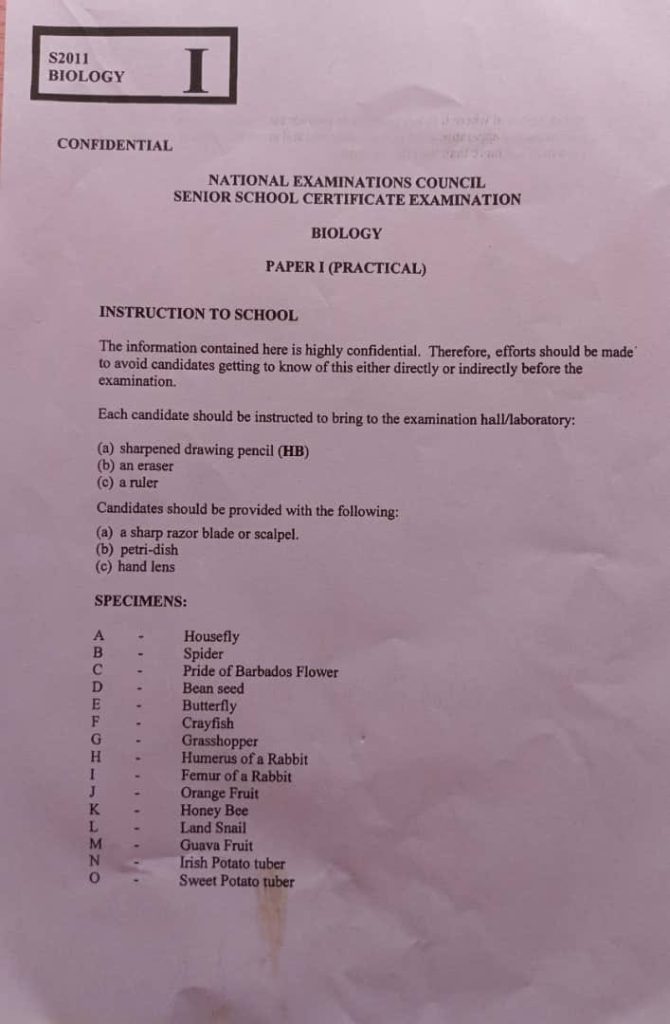
These specimens cover a wide range of biological concepts, including plant and animal anatomy, adaptations, and reproductive structures. Candidates will likely be asked to draw, label, or describe these specimens, so familiarity with their features is crucial.
Sharing Specimens
If a school cannot provide each candidate with their own set of specimens due to limited resources, NECO allows groups of up to 10 candidates to share one set. Schools should organize these groups in advance to ensure smooth access to specimens during the exam. Proper labeling and arrangement of specimens will help avoid confusion and save time.
Teacher’s Report
Teachers play a vital role in the successful conduct of the Biology Practical exam. NECO provides a report form that teachers must complete and submit after the exam. Here’s what teachers need to do:
- Receive the report form: On the day of the exam, teachers will get a proforma to guide them in setting up the practical.
- Set up the practical: Arrange the specimens and equipment in the laboratory, ensuring everything is ready before candidates arrive.
- Complete the report: After the exam, fill out the report form with the following details:
- Specimen information: List the types of specimens provided and confirm they match the required list.
- Procurement challenges: Note any difficulties in obtaining specific specimens, such as scarcity or high cost.
- Candidate issues: Report any problems faced by candidates, such as damaged specimens or equipment malfunctions.
- Submit the report: Enclose the completed report form in the envelope with the candidates’ scripts when returning them to NECO.
This report helps NECO ensure fairness and address any issues that may affect candidates’ performance.
Confidentiality and Exam Integrity
The details of the Biology Practical, including the specimen list, are highly confidential. Schools must take the following steps to maintain secrecy:
- Store the specimen list and related documents securely, accessible only to authorized staff.
- Avoid discussing the specimens with students or anyone outside the exam preparation team.
- Monitor the laboratory setup to prevent unauthorized access before the exam.
Leaking this information could give some candidates an unfair advantage, compromising the integrity of the exam. Schools found violating these rules may face penalties from NECO.
Tips for Schools and Teachers
To ensure a smooth Biology Practical exam:
- Plan ahead: Source the specimens early, as some, like the rabbit bones or specific fruits, may be harder to obtain.
- Check equipment: Verify that razor blades, petri dishes, and hand lenses are functional and sufficient for all candidates or groups.
- Prepare the lab: Arrange the laboratory in an organized way, with clear labels for each specimen to avoid confusion.
- Train invigilators: Ensure invigilators understand the rules and can assist candidates without giving hints or answers.
Tips for Candidates
While candidates won’t know the exact specimens before the exam, they can prepare by:
- Practicing drawing and labeling diagrams of common plants, animals, and biological structures.
- Learning to use a hand lens and scalpel safely for observing and dissecting specimens.
- Reviewing key biology topics like plant and animal anatomy, reproduction, and adaptations.
- Bringing well-sharpened pencils, a good eraser, and a ruler to avoid delays during the exam.
Conclusion
The NECO Biology Practical examination for 2025 is an opportunity for students to demonstrate their practical biology skills. By following the guidelines, schools can provide a fair and well-organized exam experience. Teachers’ reports are crucial for addressing any challenges, while candidates’ preparation with the required tools will help them perform at their best. Schools must uphold the confidentiality of the specimen list to ensure the exam remains fair for all. With proper planning and adherence to NECO’s rules, the 2025 Biology Practical will be a success for students, teachers, and schools alike.